
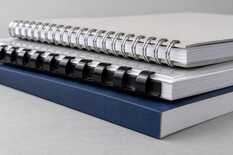
Bind a report with a plastic comb; a presentation, menu, notebook or calendar with 3:1 metal wire; a catalogue of a few dozen copies or more with hot-melt glue. For a 50-sheet report, wire and coil cost only UAH 1.3–1.5 more than a comb. Choose by whether the document has to lie open, whether sheets will need adding and how much time you have for the run. A single copy is faster on a manual binder: a thermal binder needs 15–20 minutes to heat up.
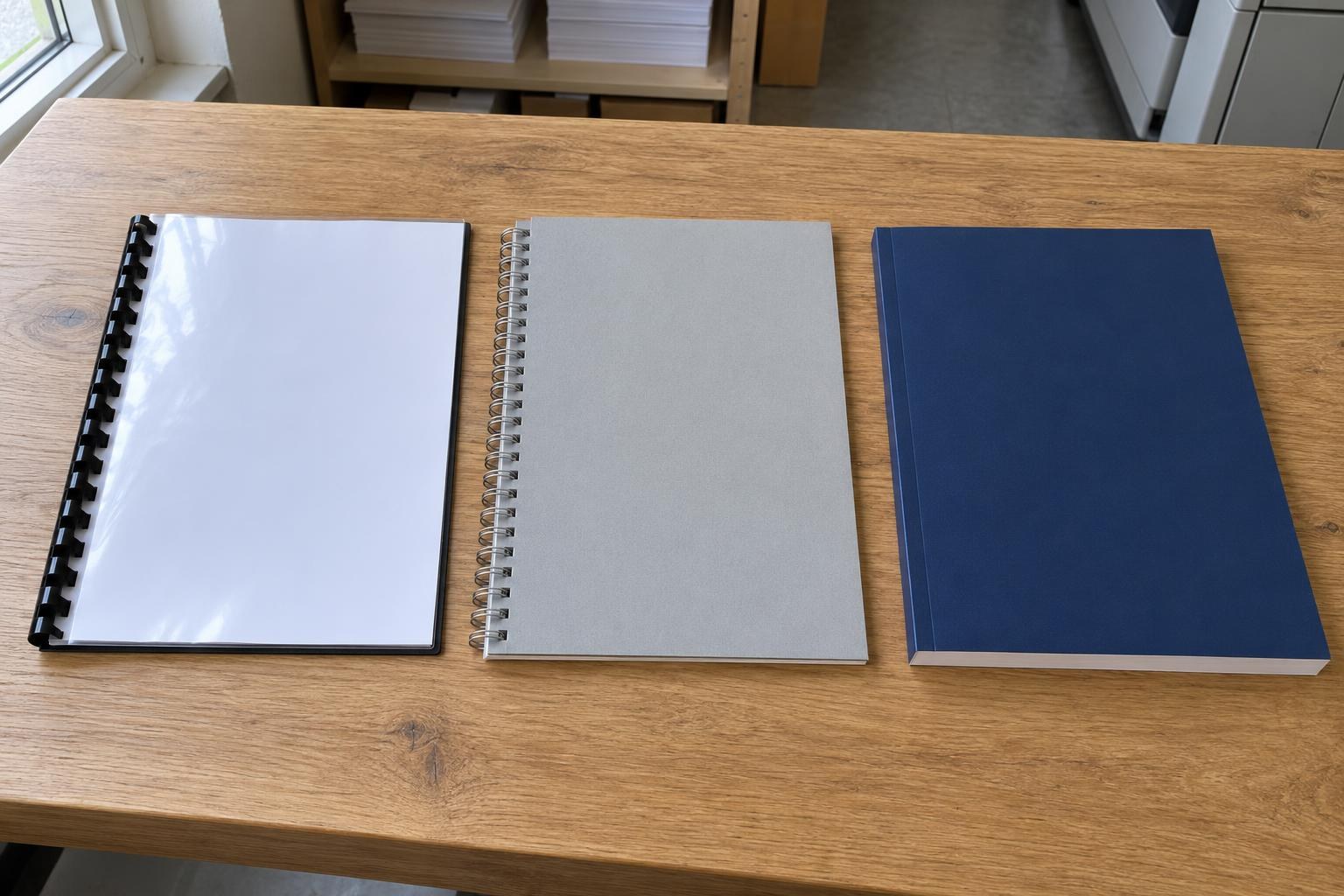
Left to right: a comb under a clear cover, 3:1 metal wire and a glued spine that can carry a printed title.
Four bindings side by side
MyPrint sells machines for all four bindings in the “Binding equipment” section, and combs, wires, coils and covers in “Binding supplies”.
| Binding | When to choose | Sheets | Per copy: time and cost |
|---|---|---|---|
| Plastic comb | Working report or manual: a sheet can be added later. Lies open but does not fold back 360° | 1–250 (comb 6–28 mm) | 1–1.5 min · UAH 8.45 |
| Metal wire 3:1 | Presentation, menu, notebook, calendar. Lies flat, folds back 360°, looks more upmarket. No adding sheets | 15–120 (6.4–14.3 mm); up to 140 with 2:1 wire | 2–3 min · UAH 9.74 |
| Plastic coil 4:1 | Notebook, workbook. Flexible, folds back 360°. Both ends must be bent in, or it unwinds | 30–220 (8–25 mm) | 2–3 min · UAH 9.93 |
| Hot-melt glue | Catalogue, annual report in a run: a square spine with a title, like a book. Does not lie open | from ≈30 (3 mm spine) to 400–600 (40–60 mm) | 15–20 min warm-up, then up to 120–250 copies an hour · glue ≈UAH 0.4 + cover |
Prices here and below are from MyPrint product pages as of October 2026; the table assumes a 50-sheet report on 80 g/m² paper, printing excluded: comb, wire and coil are priced with a clear (180 µm) and a card cover, hot-melt glue as glue only; count the wrap-around cover separately. Times are a guide for one person on a manual machine; time your own first ten copies.

A report on metal wire lies flat and its pages fold back 360°; a comb-bound one lies open but does not fold back like that.
What to use for each document
Report, manual · 20–150 sheets
Plastic comb
The cheapest, and a sheet can be added later. 50 sheets: a 10 mm comb, UAH 8.45 with covers. One report takes 1–1.5 min, 200 take 3 h 20 min – 5 h. A final report for a client, up to 120 sheets, goes on metal wire.
Presentation · 10–40 sheets
Metal wire 3:1
Lies flat, folds back 360° and looks more upmarket. 20 sheets: 6.4 mm wire, UAH 8.48 with covers, 2–3 min a copy. Bind a landscape A4 presentation along its 210 mm short edge with 3:1 wire cut down to 24 loops with side cutters.
Menu · 6–12 laminated sheets
Metal wire 3:1
The menu lies open on the table, and the laminated pages can be wiped clean. 8–10 laminated sheets: 7.9 mm wire, UAH 2.88. Laminate first, then punch two or three sheets at a time. A new seasonal menu gets a new wire.
Notebook, wall calendar
Metal wire or coil
A 50-sheet notebook: 9.5 mm wire with two card covers, UAH 9.06; 10 mm coil, UAH 9.25. Either way the open notebook lies flat, so it is easy to write in. A calendar goes only on wire with a hanger.
Catalogue · from 30 sheets
Hot-melt glue; 1–2 copies on wire
A square spine with a title, so the catalogue stands on a shelf. The spine needs at least 3 mm, about 30 sheets; a thinner catalogue, or a price list that lies open on the counter, goes on wire. Warming up the TB Base 05 and gluing 200 catalogues takes from 1 h 55 min; trimming on the guillotine comes after.
Wall calendar: wire, hanger and notch
A calendar is bound with 3:1 wire, and a hanger, a wire hook, is laid inside it; the hook comes out through a half-round notch in the middle of the edge. An ordinary wire binder does not cut this notch, so you need a calendar binder. Take a hanger at least 2 cm shorter than the edge: 250 mm for A3 bound on its 297 mm edge, 150 mm for A4 bound on 210 mm. A 13-sheet A3 calendar costs UAH 4.18–4.90: 6.4 or 7.9 mm wire plus a 250 mm hanger.
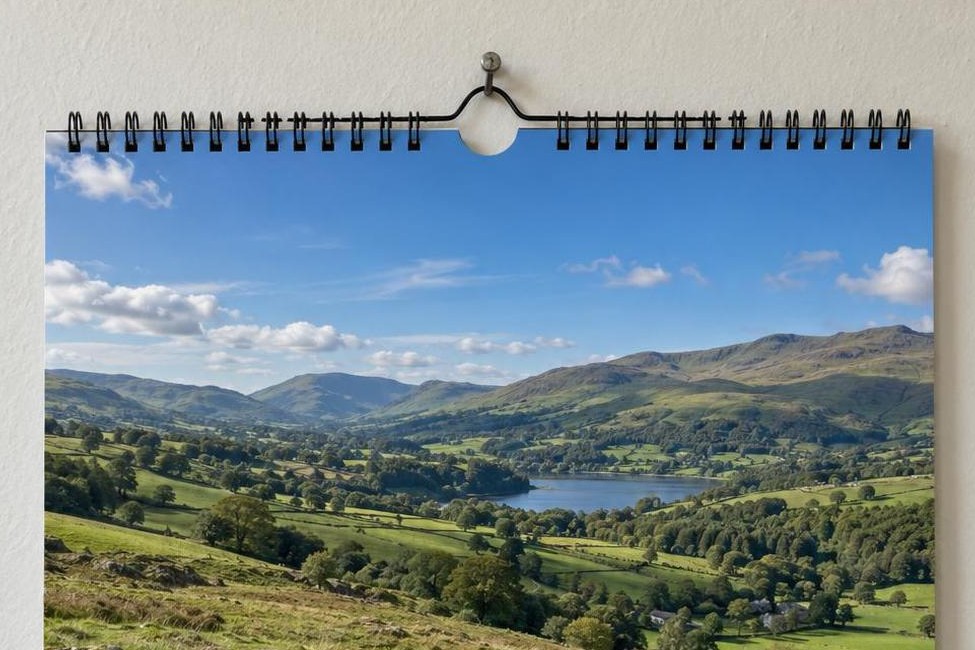
The hanger runs inside the wire; above the notch where the hook comes out, the loops are snipped off with side cutters.
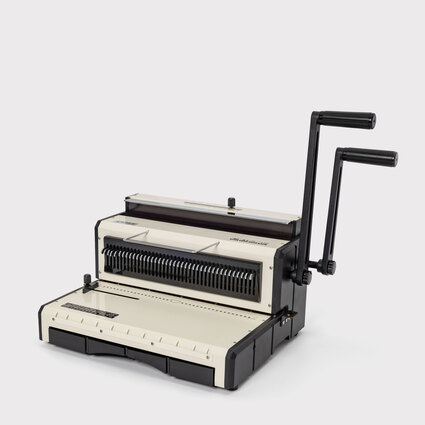
WB Calendar 930 calendar binder
Holes for 3:1 wire and the half-round hanger notch · up to 25 sheets per pass · formats up to F4 · UAH 17,180
1, 20 or 200 copies: what the run changes
The run rarely changes the binding; it changes the machine and the hours. One copy takes 1–3 minutes on a manual binder. 20 copies take 20–30 min on comb and 40–60 min on wire or coil, so the look still decides. At 200 copies the difference is counted in hours.
Inputs: 40 sheets of 80 g/m² paper make a spine of about 4 mm; one person does the work.
Example: 200 A4 catalogues of 40 sheets
The glue time excludes printing, scoring and trimming the covers. Glue: 1.2 g per catalogue, per a glue-binder maker’s figures.
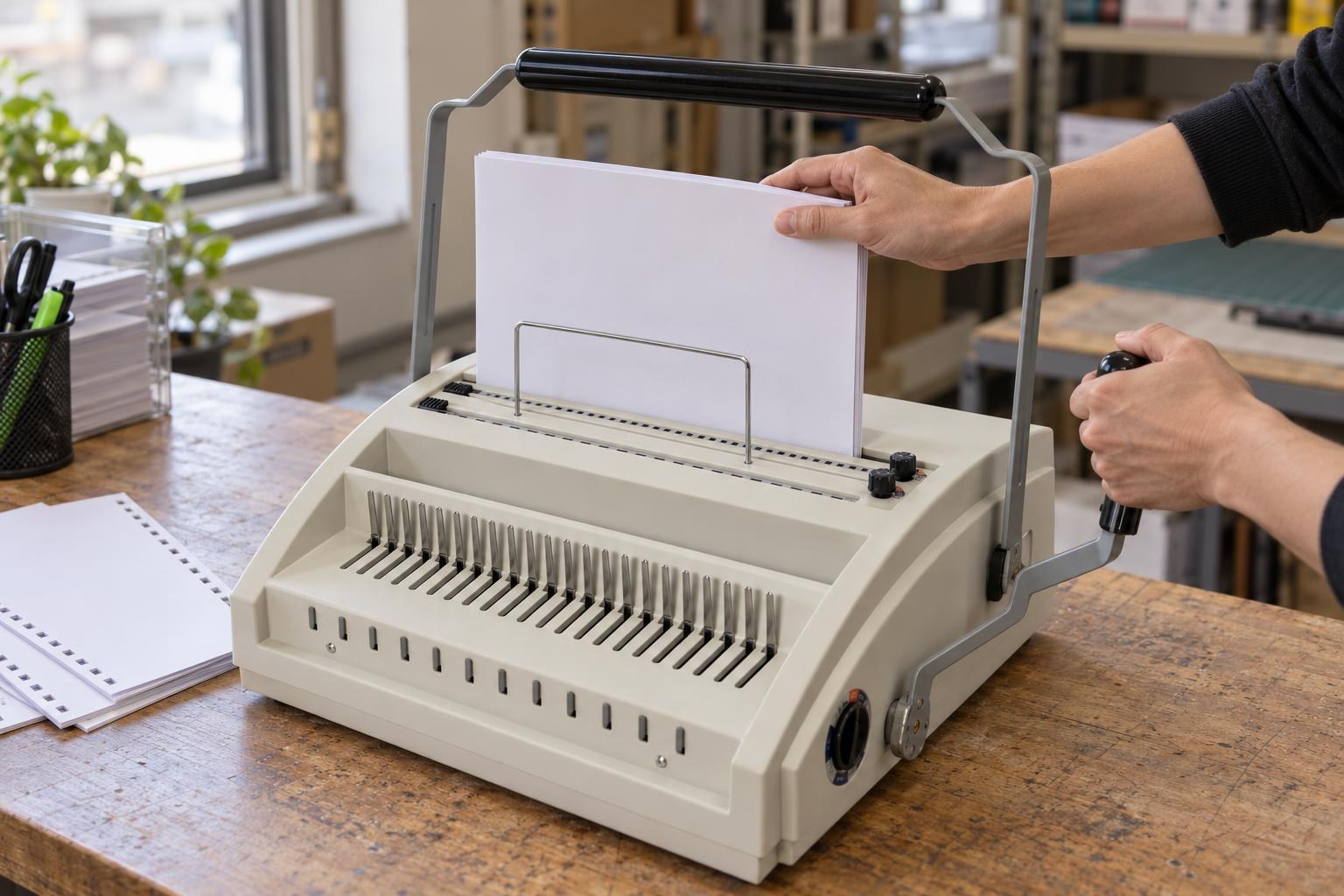
Punching takes the longest: 50 sheets on a manual binder means three or four passes.
For hundreds of copies a week there are electric machines: the CB Auto 8808 (comb) and WB Auto 8707 (wire) punch up to 30 sheets of 70 g/m² paper from a foot pedal, and the CL Auto 8706 also spins the coil in by itself.
One machine for several documents
Reports on comb and presentations on wire are a typical office pair, and the CW 870 combination binder does both, with a separate margin setting for each. There are also wire + coil (WC 2917) and comb + coil (CC 2916) pairs.
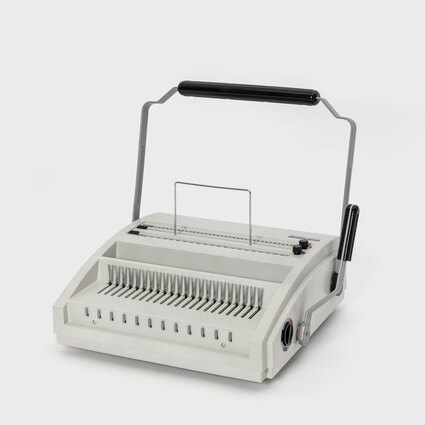
CW 870 2-in-1 comb and wire binder
Plastic comb and 3:1 metal wire · 22 sheets per pass · up to 120 sheets on wire · UAH 14,915
Two machines cost less than one combination. The manual CB Base 615 (comb) and WB Base 619 (wire) together cost UAH 11,455, which is UAH 3,460 less than the CW 870, and two people can work on them at once. Take the CW 870 when the desk has room for only one machine.
Hot-melt glue: what you need besides the machine
The cover is printed as one wrap-around sheet (front, spine and back) slightly larger than the block, and after gluing the catalogue is trimmed flush on a guillotine: the manual GC Base 198 A4 takes a stack up to 40 mm. For an A4 catalogue with a 4 mm spine the cover spread is 424 × 297 mm before trim allowances, so it is printed on an SRA3 sheet (450 × 320 mm), not on A3. A heavy cover is scored along the spine so it does not crack at the fold. The TB Base 05 has a built-in scoring unit.
The machine mills the spine so the glue reaches every sheet; the article “Glue-bound booklet: why the spine is milled” explains why. Get the glue from the “Glue for thermal binders” section: BB Manual for the TB Base 05 (it works at 150–170 °C) and BB Universal for the TB Base 470 Auto, as that machine’s product page recommends. A 25 kg bag is enough for about 8,000 catalogues with a 10 mm spine.
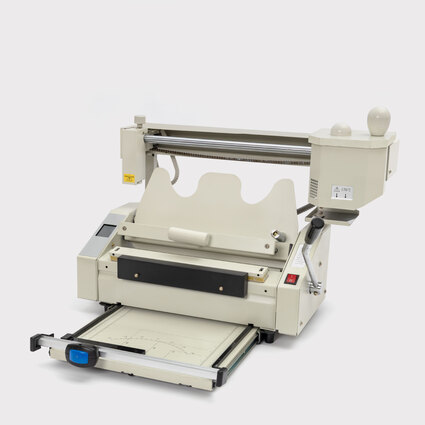
TB Base 05 A4 2-in-1 desktop thermal binder
Gluing and cover scoring · spine milling · block up to 40 mm · about 15 min warm-up · UAH 39,625
For a steady flow there is the TB Base 470 Auto at UAH 65,780: it clamps, mills, glues and nips by itself, up to 250 books an hour.
Before the run
Check five things
Frequently asked questions
Can I add a sheet to a report bound with metal wire?
No: a closed wire cannot be opened without ruining it, so you fit a new one. Only a comb takes an extra sheet without rebinding; the article “How to replace a page in a comb-bound catalogue” shows how.
Does a plastic comb hold the sheets securely?
It holds if you choose the comb by the sheet capacity on its product page, allowing for the covers: use a 10 mm comb for 50 sheets of 80 g/m² paper with two covers. A manual that is leafed through every day is sturdier on metal wire.
Can laminated sheets be punched and bound?
Yes. Laminate first, punch one test sheet, then go on two or three at a time: a laminated sheet is thicker than plain paper.
Which binder takes a 25 mm binding element?
A 25 mm comb (200–230 sheets) fits any 21-hole comb binder, and a 25 mm coil (190–220 sheets) fits a 4:1 coil binder. MyPrint’s metal wire goes up to 14.3 mm (3:1, up to 120 sheets) and 15.9 mm (2:1, up to 140 sheets).