
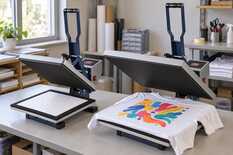
A plate is not usable right to its edge: the print goes about 2.5 cm in from the edges, so a 38 × 38 plate takes prints up to 33 × 33 cm and a 40 × 50 plate up to 35 × 45 cm. The first is enough for T-shirts with a print up to 30 × 30 cm or A4, kids' T-shirts, a hoodie front above the pocket and one A4 puzzle or mouse pad at a time. Take the 40 × 50 when your orders include A3, a full XXL front, a large tote print, up to 35 × 45 cm, or two items per pressing.
How much of the plate takes the print
A plate cools faster at the edges than in the centre, because heat also escapes through its sides. So the print stays about 2.5 cm in from the edge, which means the plate must be 5 cm larger than the print in each dimension.
MyPrint's flatbed heat presses for T-shirts and fabric come with plates from 21 × 28 to 40 × 60 cm. Those smaller or narrower than 38 × 38 will not take a 30 × 30 cm print, so for T-shirts, hoodies, tote bags and puzzles we compare 38 × 38 and 40 × 50.
38 × 38
area 33 × 33
40 × 50
area 35 × 45
Both plates to the same scale. Dashed line: the working area 2.5 cm in from the edges; blue: a 30 × 30 cm print and an A3 sheet, 29.7 × 42 cm.
What fits on each plate
Item sizes come from MyPrint's product cards; print sizes are typical for garments. Counts allow 2.5 cm from the edges and a gap between items; items may be turned.
| What you print | 38 × 38 | 40 × 50 |
|---|---|---|
| Kids' T-shirt, print up to 25 × 30 cm | yes | yes |
| T-shirt, print up to 30 × 30 cm or A4 | yes | yes |
| T-shirt, A3 print, 29.7 × 42 cm | no | yes |
| Full XXL front, up to 34 × 42 cm | no | yes, tight |
| Hoodie, front above the pocket up to 30 × 25 cm | yes | yes |
| Hoodie, A3 back | no | yes |
| Tote bag 38 × 38 × 6 cm, print up to 33 × 33 cm | yes | yes |
| Tote or bag, full-panel print 40.5 × 35.5 or 38 × 48 cm | no | no: use a 50 × 60 plate |
| Bag, full-panel print 45 × 34 cm | no | yes |
| Puzzle A5, 15 × 20 cm | 2 pcs | 4 pcs |
| Puzzle A4, 20 × 29 cm | 1 pc | 2 pcs |
| Puzzle A3, 28.3 × 39.4 cm | no | 1 pc |
| Mouse pad 22 × 18, 24 × 20 or 26 × 21 cm | 1 pc | 2 pcs |
| Mouse pad 36 × 29.5 cm | no | 1 pc |
| Mouse pad 49 × 38 cm | no | no: it needs a plate from 50 × 60, which means industrial heat presses |
T-shirts: from kids' sizes to XXL
If a T-shirt slips easily over the lower plate, slide it on as you would onto an ironing board. The back will stay under the plate, and the design will not transfer onto it. Do not stretch a narrower one onto the plate: stretched knit shrinks back after pressing and distorts the print. Lay it flat with a protective sheet between the layers (where exactly to put it so the design does not transfer to the back).
Kids' T-shirts are more often narrower than the plate. On a 40 × 50 there are more such sizes than on a 38 × 38. Measure the T-shirt across under the arms and compare it with the plate width. A kids' print up to 25 × 30 cm fits on a 38 × 38 too, so kids' orders do not need the large plate.
Large prints are where the plates differ. A print up to 30 × 30 cm and A4 fit both, while A3 and a full XXL front up to 34 × 42 cm fit only the 40 × 50. The height of such a print must run along the plate's longer side, 50 cm. If the T-shirt pulled onto the plate does not lie that way, lay it flat across the plate with a sheet inside.
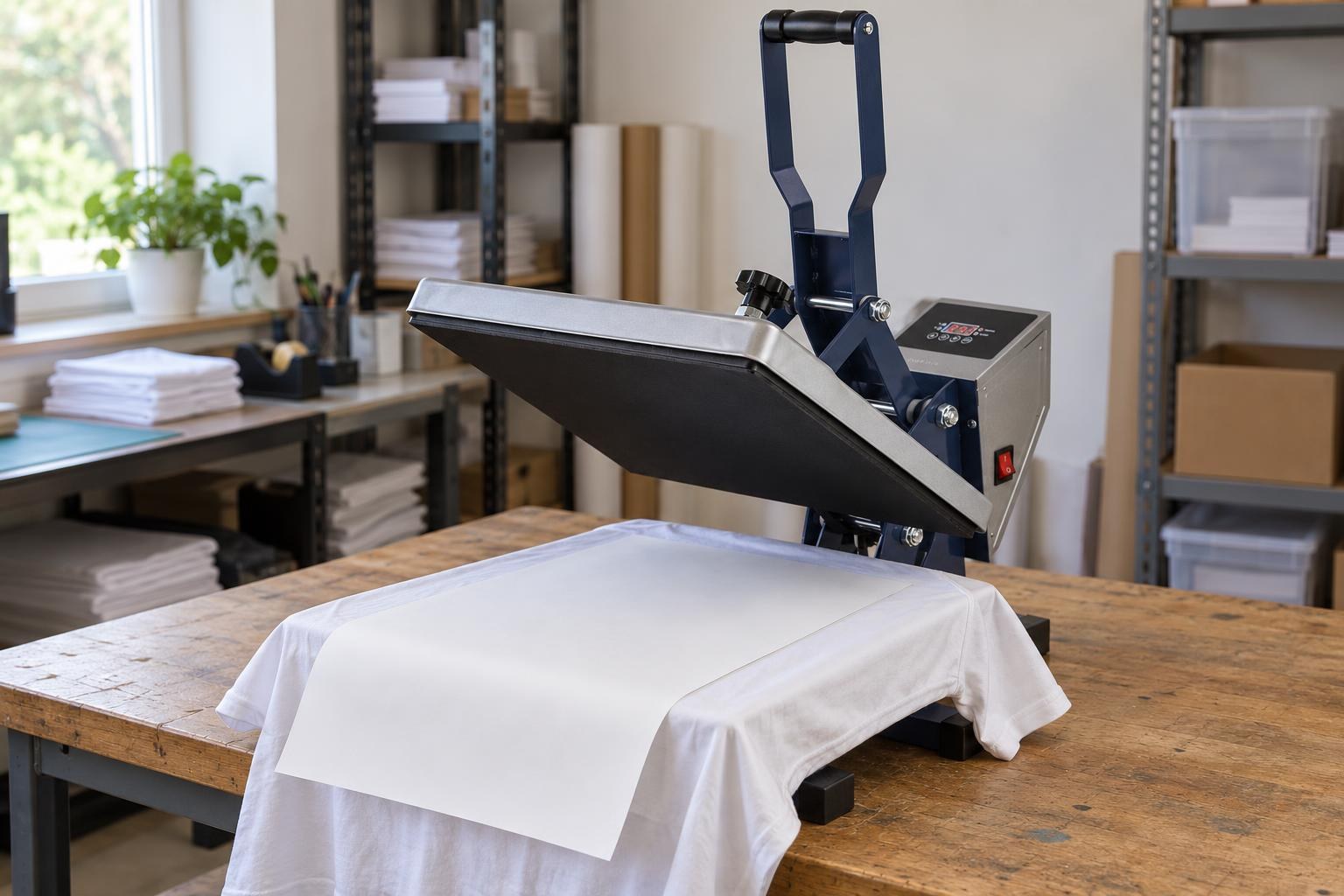
Wrong: on a 38 × 38 plate the A3 sheet hangs over the edge, and the bottom of the print will not be pressed.
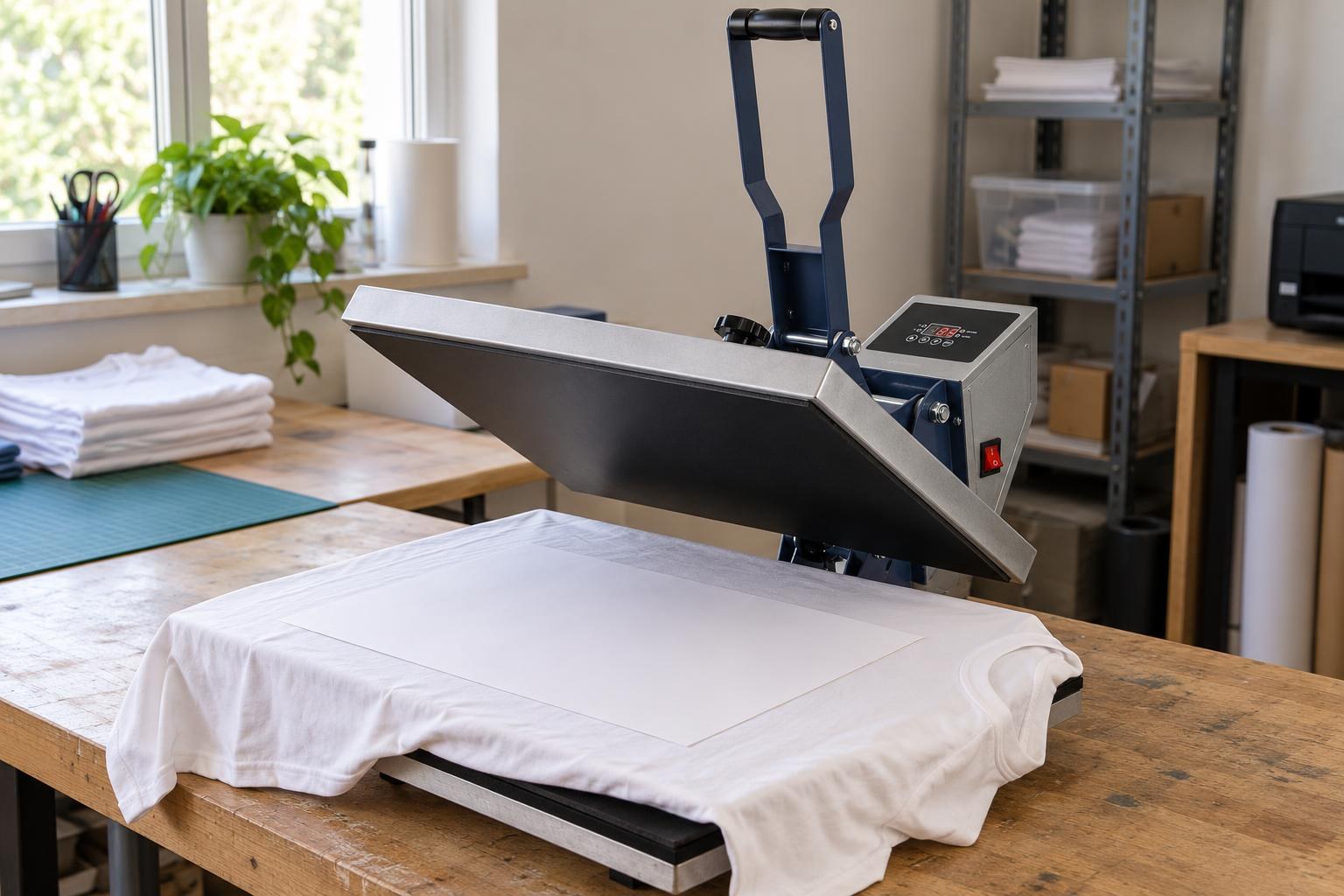
Right: on a 40 × 50 plate the T-shirt lies across, and the same sheet has room to spare at the edges.
Hoodies and tote bags
A hoodie front print above the pocket, up to 30 × 25 cm, fits on both plates. Position the pocket seam off the edge of the plate. If it remains under the plate, insert a heat-resistant support beneath the entire print area to raise it above the seam; adjust the pressure with the support in place. Keep the bottom of the print at least 2.5 cm above the seam and let the hood hang off the plate. A large back print, such as A3, fits only the 40 × 50.
Lay a tote bag flat with the handles over the edge of the plate and a support inside under the whole print area (how to choose the support inside a tote bag). A 38 × 38 plate is enough for a 38 × 38 × 6 cm tote with a print up to 33 × 33 cm. For larger bags, choose the print size first: on a 40 × 50 plate it must fit within 35 × 45 cm.
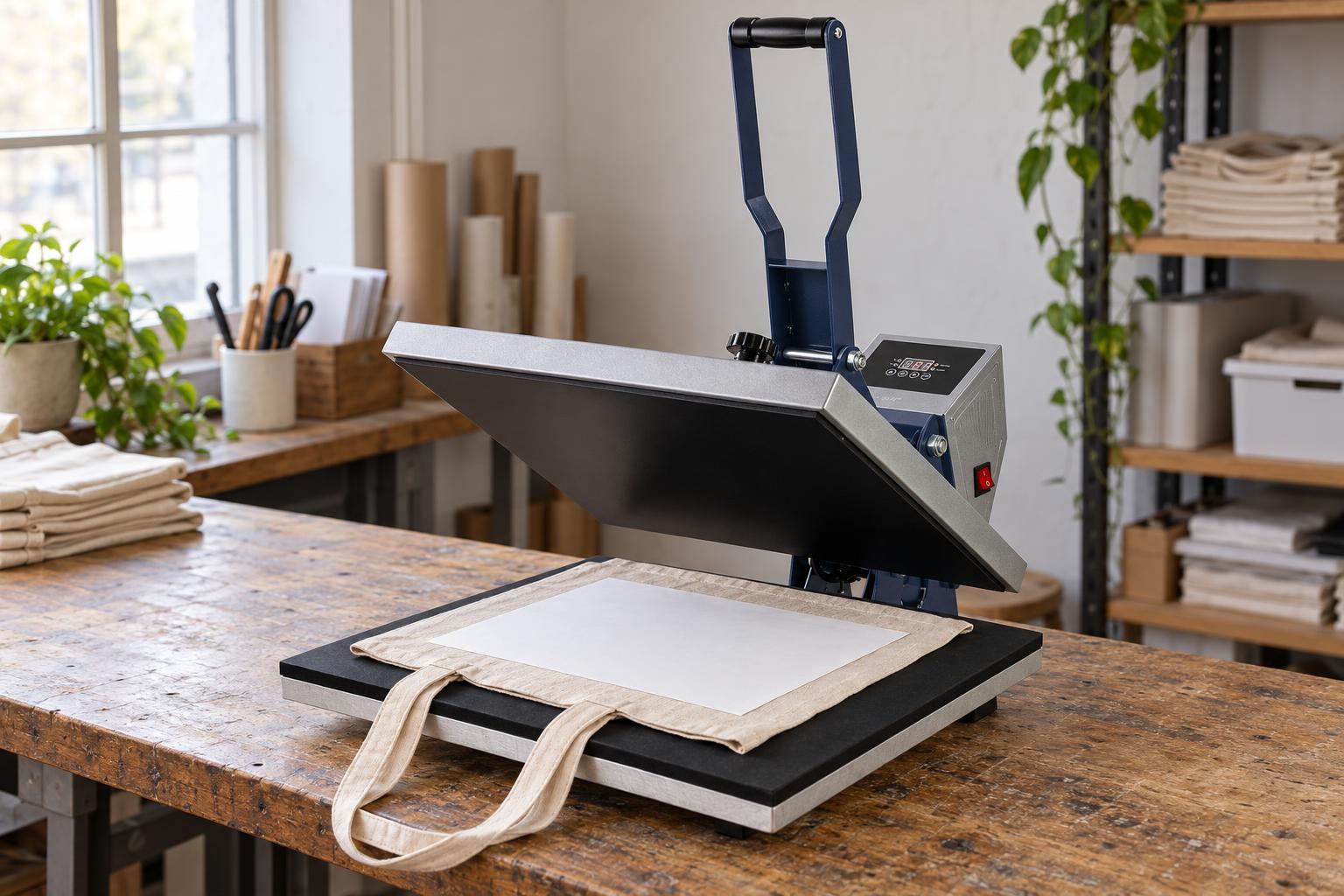
The tote bag's handles hang over the edge of the plate; the print lies within the working area.
Two items per pressing
Small items are where the large plate gains the most. In the same cycle a 40 × 50 takes two A4 puzzles instead of one, four A5 instead of two, two 24 × 20 or 26 × 21 cm mouse pads instead of one. Lay the items out symmetrically around the centre of the plate, with a gap between them and no closer than 2.5 cm to the edge.
One pressing, identical items. Different thickness means different pressure: the thinner item gets pressed less firmly and comes out paler. After two cold items, wait until the display shows the set temperature again.
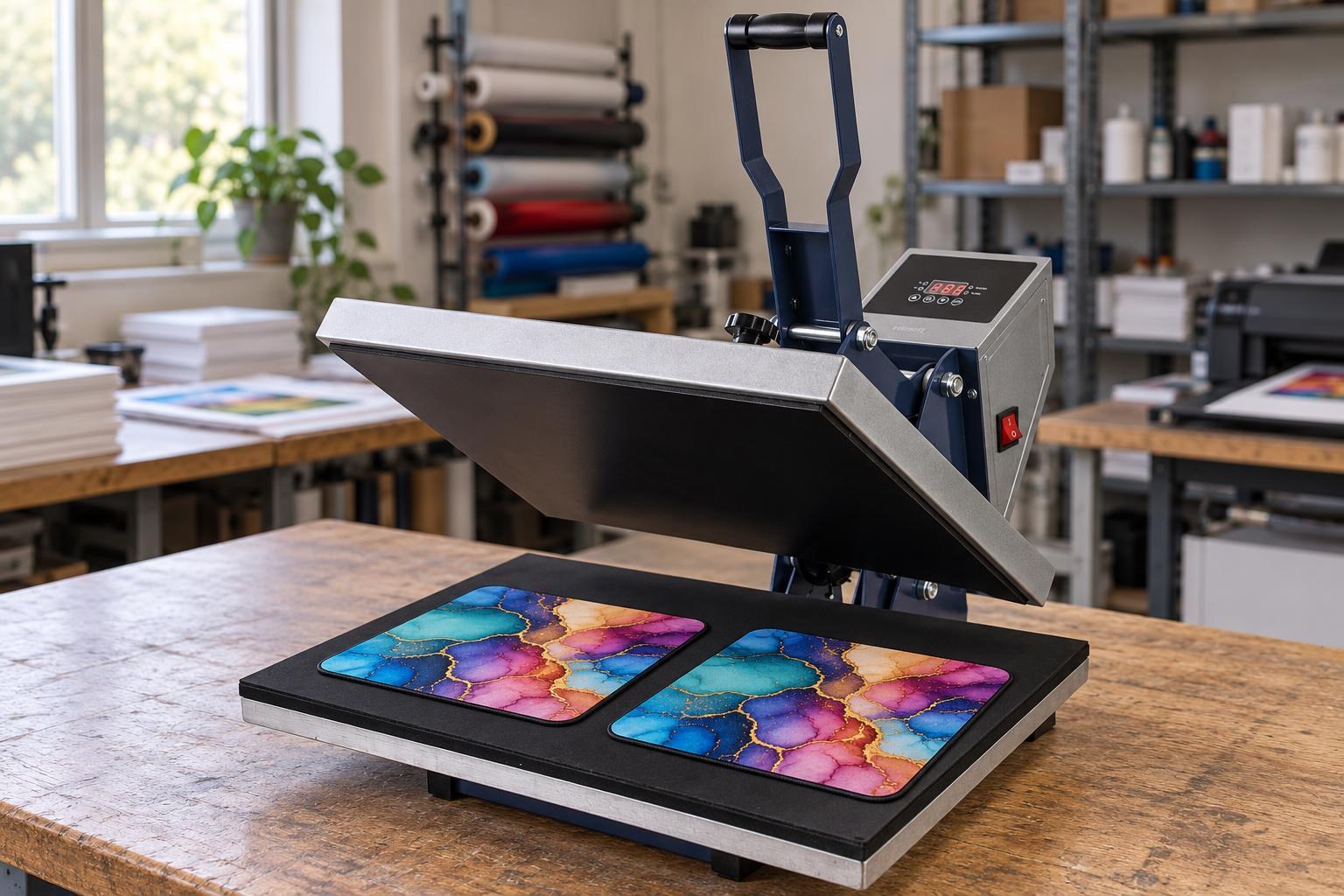
Two identical mouse pads placed symmetrically around the centre of the plate, with a gap between them.
Clamshell, swing-away or drawer
MyPrint sells each of the three types with both a 38 × 38 and a 40 × 50 plate. The mechanism decides where the hot head goes while you lay out the item and how much space the press needs around it.
| Type | When to choose it | MyPrint models |
|---|---|---|
| Clamshellthe head opens upward | T-shirts and hoodies one at a time, tight space. While you lay out the item, your hands work under the open hot plate. | HP380A NEW38 × 38, 1400 WHP450A NEW40 × 50, 1600 W |
| Swing-awaythe head swings to the side | Puzzles and mouse pads several at a time, thick items: the plate is clear for layout and the head comes straight down. | HP380R38 × 38, 1600 WHP450R40 × 50, 2200 W |
| Drawerthe lower plate slides out toward you | Layout away from the hot head when there is no room at the side. | HP380D38 × 38, 1400 WHP450D40 × 50, 1600 W |
If you are torn between a manual, pneumatic and automatic press, start with the comparison of flat, pneumatic and automatic heat presses.
Compare the power from the cards per unit of plate area: a 40 × 50 plate is almost 40 % larger than a 38 × 38, and each square centimetre of it may get fewer watts.
HP380A NEW · 38 × 38
97 W
clamshell, 1400 W
HP450A NEW · 40 × 50
80 W
clamshell, 1600 W
HP380R · 38 × 38
111 W
swing-away, 1600 W
HP450R · 40 × 50
110 W
swing-away, 2200 W
Watts per 100 cm² of plate: the power from the MyPrint card divided by the area, 1444 cm² for 38 × 38 and 2000 cm² for 40 × 50.
The fewer watts per area, the longer the plate takes to recover its temperature when cold items cover it. That is why the HP450R is the better 40 × 50 for batches of puzzles and mouse pads. Time how long your press takes to reach working temperature, so you can switch it on in advance.
Bench space
Before you set up the press
Ask a MyPrint manager for the outer dimensions of your model before you order.
What to choose for your orders
T-shirts and hoodies with a print up to 30 × 30 cm or A4, kids' sizes, one item at a time
38 × 38, clamshell
The HP380A NEW takes all of this with room to spare and needs no free space at the side or in front. For thick items, the swing-away HP380R.
A3, full XXL front, hoodie back, tote-bag prints up to 35 × 45 cm
40 × 50, clamshell
The HP450A NEW takes everything a 38 × 38 does, plus the large formats.
Puzzles and mouse pads, 2–4 at a time
40 × 50, swing-away
HP450R: layout without a hot plate over your hands and more watts per area than the HP450A NEW. No room at the side: the drawer HP450D.
Mugs, plates and caps besides textiles
Multifunction 38 × 38
Multifunction heat presses with a 38 × 38 plate have the same 33 × 33 cm working area plus attachments for other items. For A3 and two A4 puzzles at a time you will also need a 40 × 50.
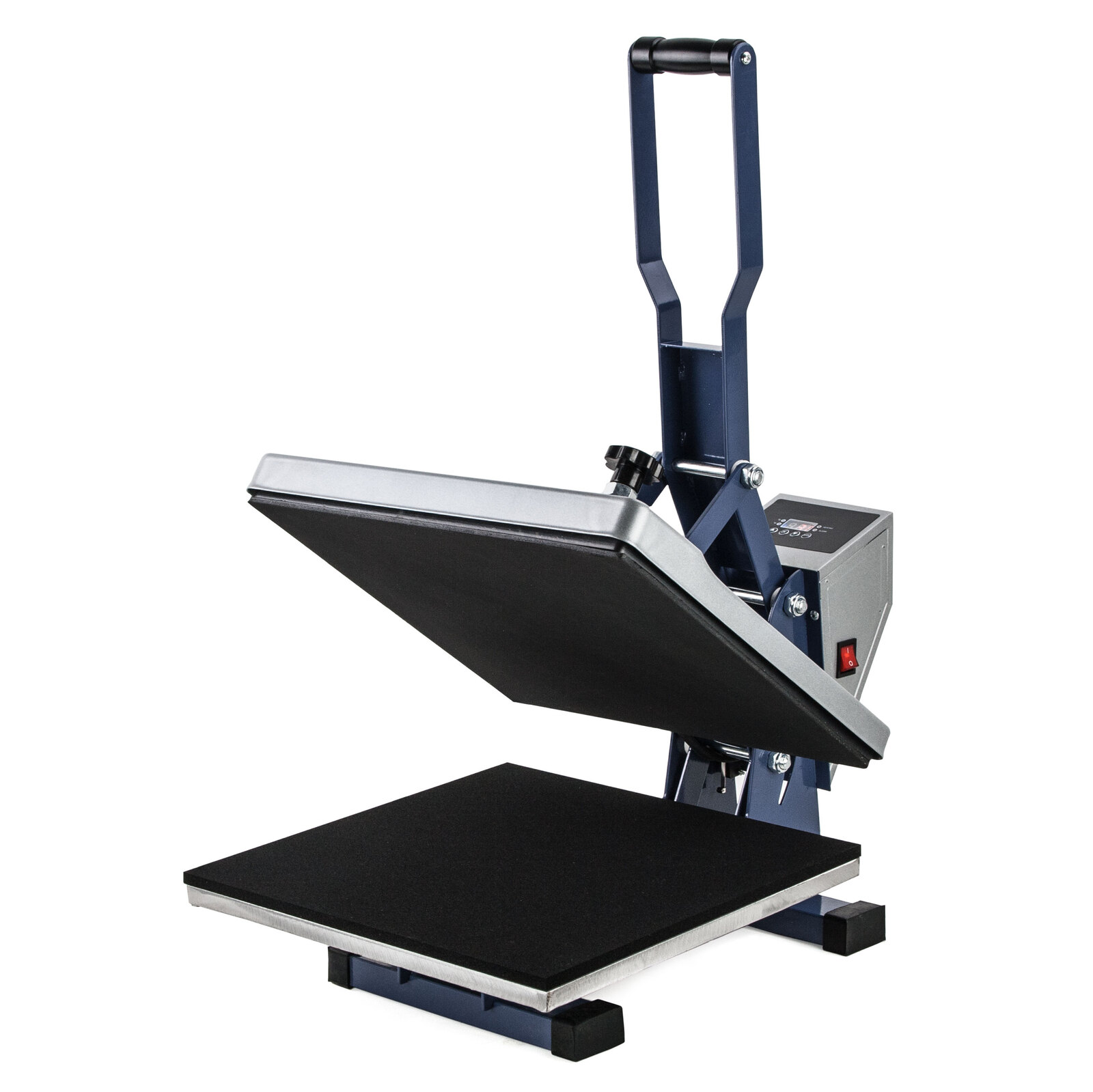
HP380A NEW 38 × 38 flatbed heat press
Plate 38 × 38 cm · clamshell · 1400 W · 0–230 °C · timer 1–999 s
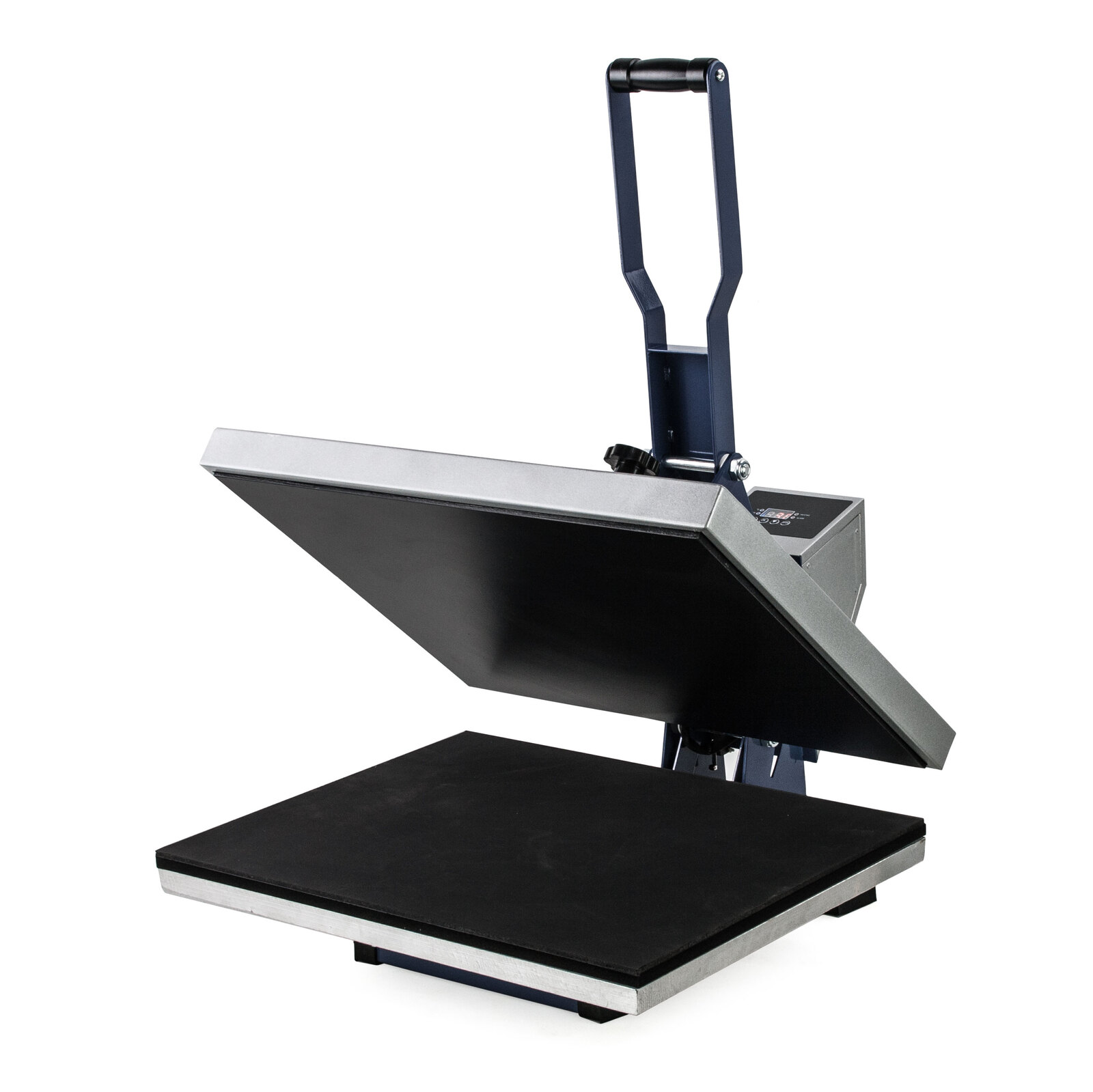
HP450A NEW 40 × 50 flatbed heat press
Plate 40 × 50 cm · clamshell · 1600 W · 0–230 °C · timer 1–999 s
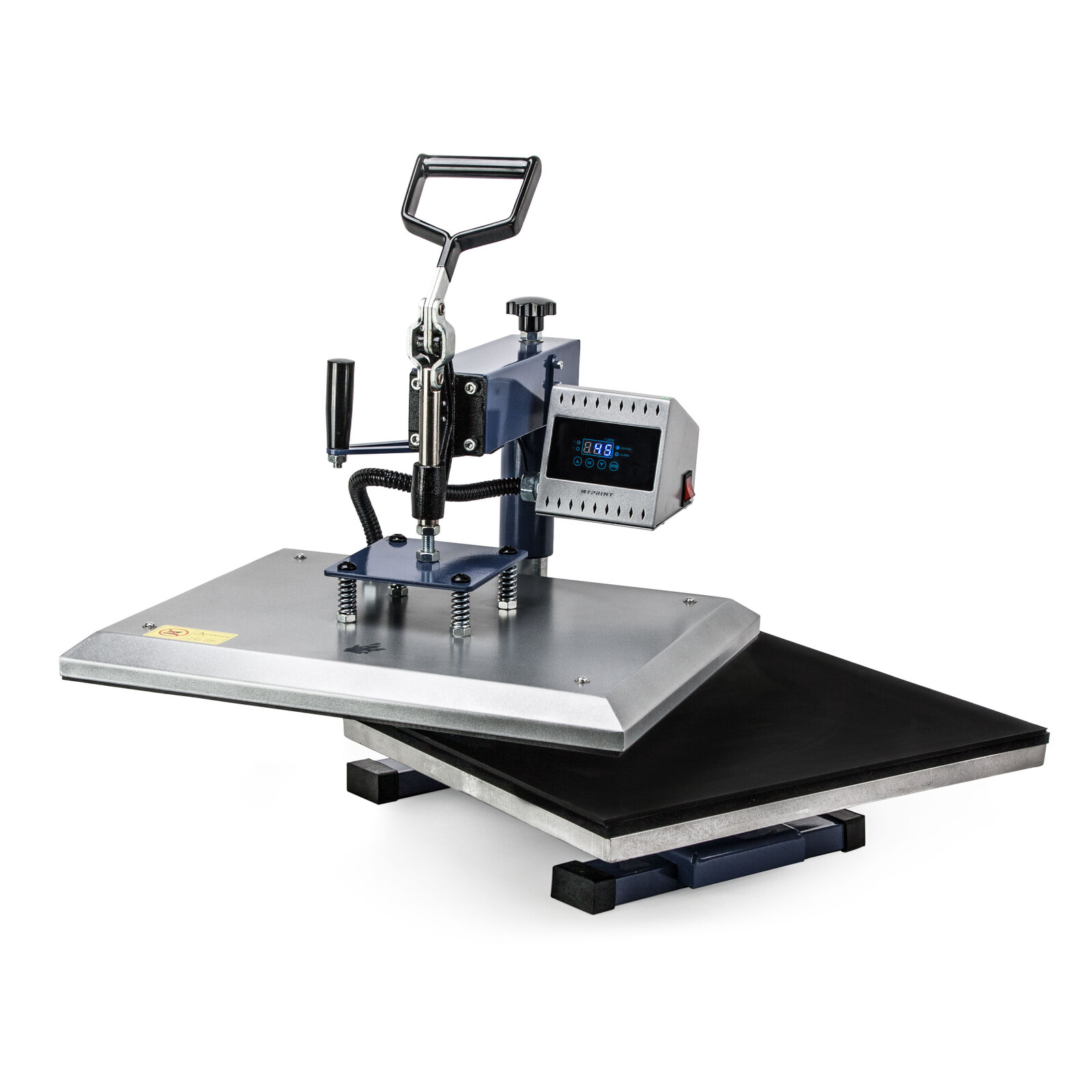
HP450R 40 × 50 flatbed heat press
Plate 40 × 50 cm · swing-away · 2200 W · 0–230 °C · timer 1–999 s
Frequently asked questions
Will an A3 print fit on a 38 × 38 plate?
No: the long side of A3 is 42 cm and the plate is 38. Either scale the print down to 23 × 33 cm so it fits the working area, or take a 40 × 50: A3 lies on it with 4–5 cm to spare to the edges.
Can the print go closer to the edge of the plate?
Yes, if the edges of your press heat and press as evenly as the centre. Check this once (how to find a cold zone or weak contact on a heat press); on an even plate the print can come to about 1.5 cm from the edge.
Can an ordinary socket handle a 40 × 50 press?
Plug the press directly into a sound, properly earthed 16 A socket. At 230 V, the HP450A NEW draws about 7 A (1600 W) and the HP450R about 10 A (2200 W). Check the circuit's load capacity: if it is unknown, or a mug press or heater also uses that circuit, have an electrician check the wiring and circuit breaker. Do not use a multi-plug adapter or an extension cord.
Why not go straight to 40 × 60?
Its short side is the same 40 cm, so it only adds 10 cm of length. That helps with a long back print or two 30 × 25 cm mouse pads at a time. If you have no such orders, a 40 × 50 is enough.