
A laminated sticker lifts off a bottle because the protective film makes it stiff, so it springs back on the curve. Apply two identical samples, one laminated and one without laminate: if only the laminated one lifts, re-laminate without stretching and round the corners; if both lift, print on strong-hold PP film. There is no need to change the sticker width.
Why protection can lift an edge
A sticker made from self-adhesive inkjet film already has a printed face and an adhesive that holds it on the product. Cold-laminating film adds another layer with its own adhesive.
All the layers must bend together around the bottle. The thicker the sticker, the harder it springs back and pulls its edges away, and lamination adds thickness.
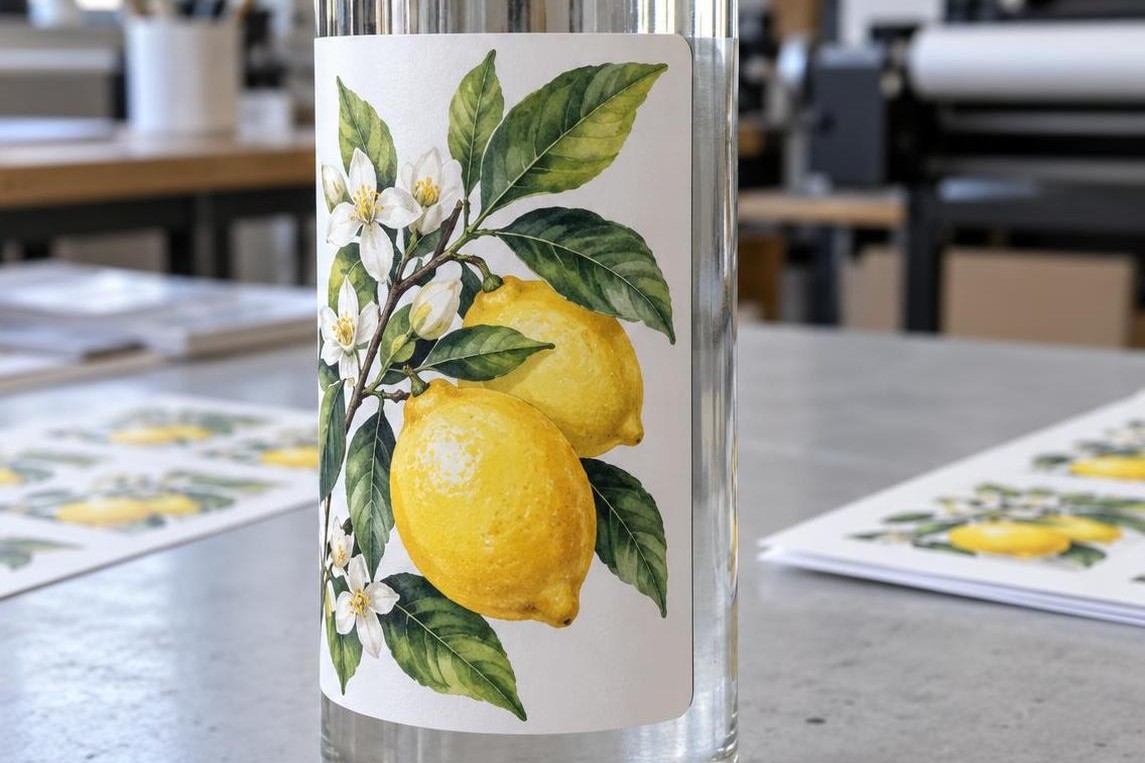
Right: the laminated sticker follows the curve, with both edges flush against the glass.
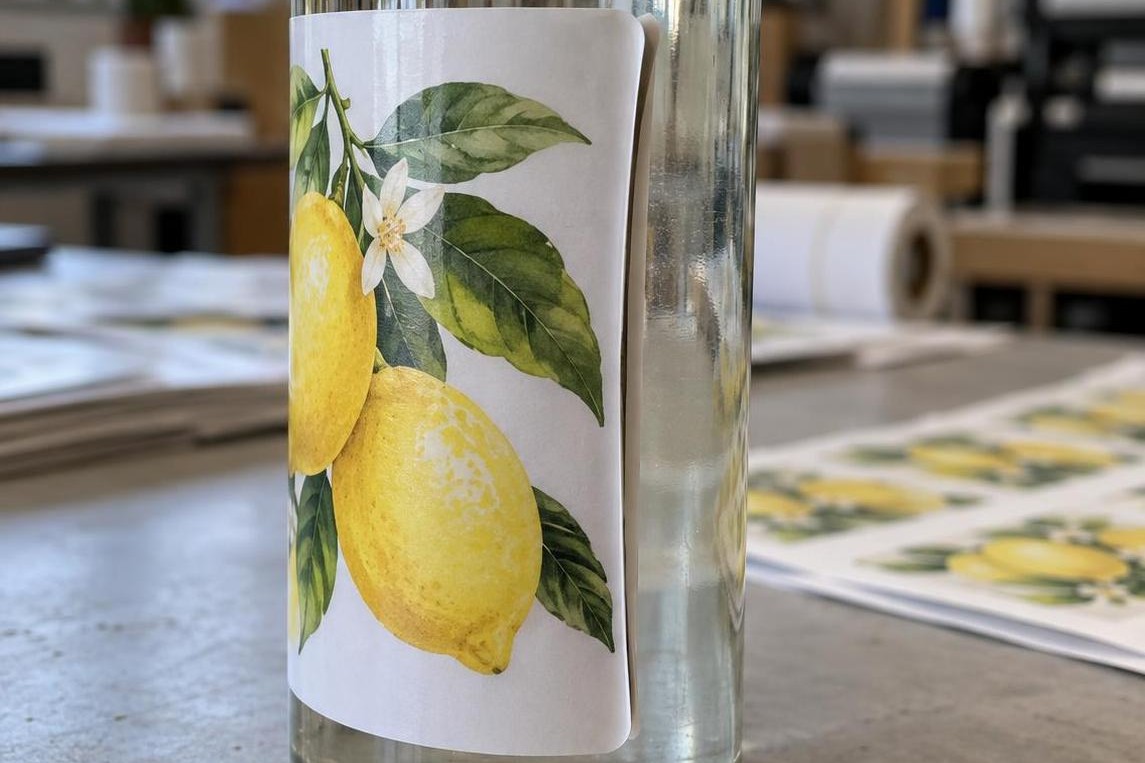
Wrong: the centre still holds, but the right edge has lifted off the glass: the stiff sticker springs back.
What lamination adds
Layer cross-section. The release liner has been removed; the protective top layer does not strengthen the adhesive holding the sticker to the bottle.
An edge lifts on the curve
Bottle wall
The stiff sticker springs flatter: its centre still touches the bottle while gaps open beneath the edges.
If the sticker curls before it reaches the bottle, check whether you stretched the protective film during lamination. Tension between layers can also pull an edge up.
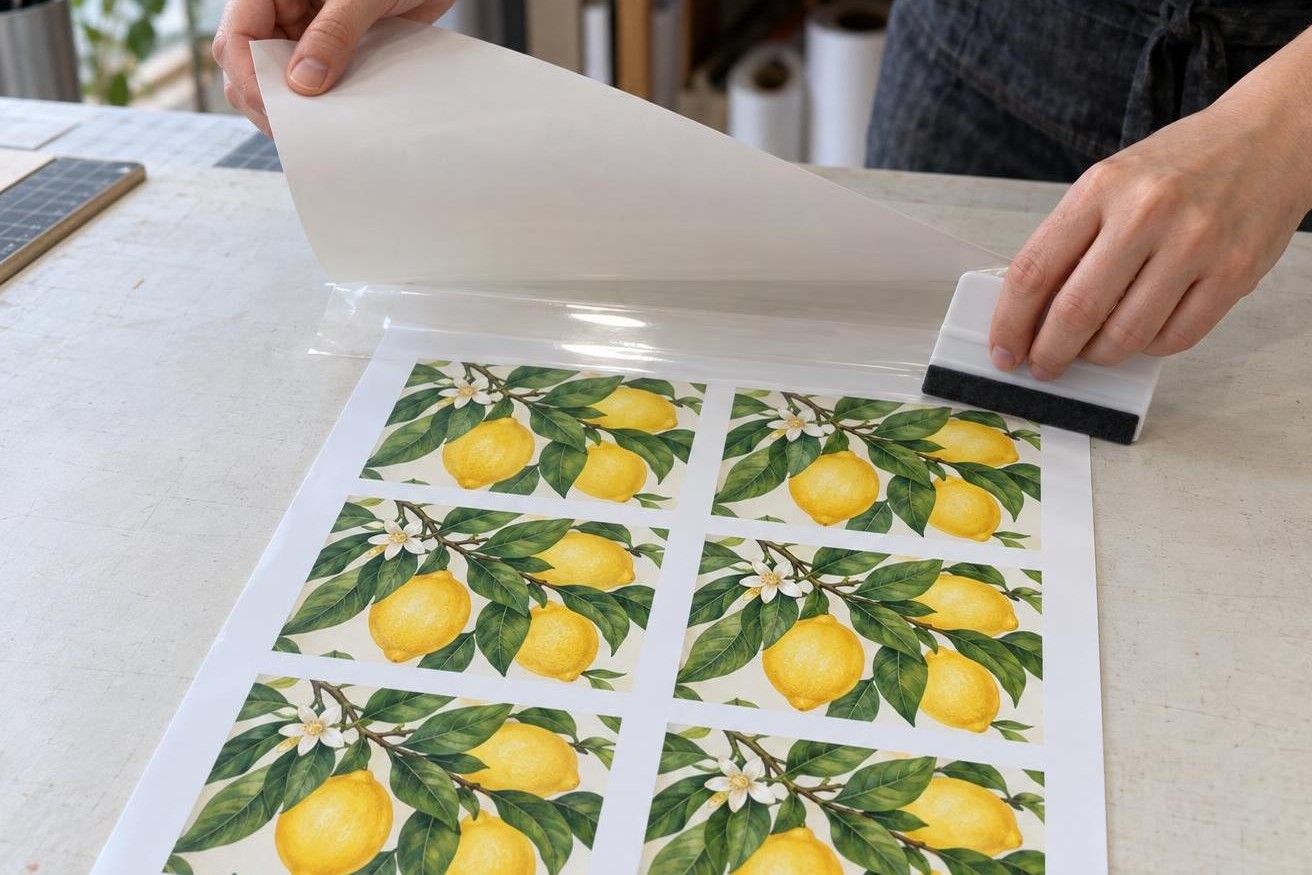
Cold-laminating film goes on from the top edge: peel the liner gradually and smooth the film with a squeegee without pulling it.
Two samples from one sheet
Use two identical straight-sided bottles and two identical stickers from one sheet. Laminate one as usual and leave the other without laminate. Apply them at the same height on the straight section, away from the shoulders and the base.
- Wipe the bottles with isopropyl alcohol and let them dry. A bottle straight from the fridge is unsuitable: the adhesive will not bond through condensation.
- Keep the sticker flat and peel the liner away from it, not the other way around. Do not touch the adhesive with your fingers.
- Press the centre down, then smooth towards both edges without stretching. Press firmly around the entire outline.
- Leave the bottles at room temperature for a day. Inspect the edges immediately and after 24 hours; do not smooth down lifted edges.
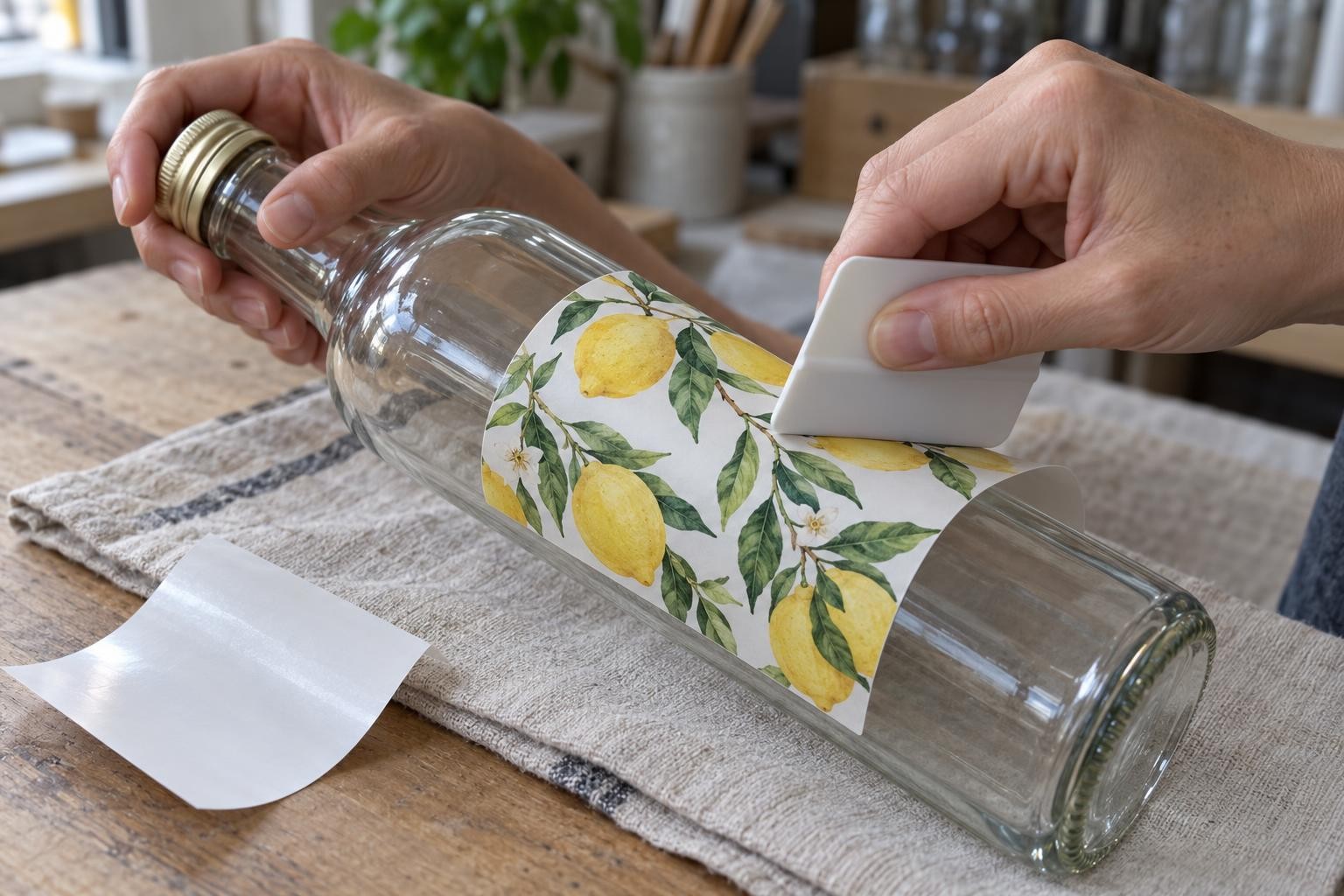
Move the squeegee from the part already pressed down towards the edge, along the curve; the cloth keeps the bottle from rolling.
Print before laminating
overnight
10–15 s on the card means touch-dry only
Sticker corners
R 3 mm
include in the cut contour
Bottle
room temp.
dry and degreased with alcohol
Before washing
24 h
at room temperature
Self-adhesive PP film, cold lamination, a smooth bottle with no condensation.
What to change after a day
| After one day | What to do |
|---|---|
| Only the laminated sample lifts | Laminate a new sticker without stretching: with the liner removed it should lie flat. If it lifts again, round the corners and apply it to the widest straight part of the bottle. If that does not help, print the same sticker on strong-hold PP film and laminate it the same way. |
| Both samples lift | The fault is the adhesive or the surface, not the laminate. Degrease the bottle with alcohol, apply the sticker to a dry bottle at room temperature and press the edges firmly. If it lifts again, print on strong-hold PP film: its adhesive also holds on rough, powder-coated and plastic surfaces. |
| Both stay down | Now test the laminated sticker the way the bottle will be used: hand-wash it, wipe it and refrigerate it. A dry sample tells you nothing about water. |

My Print strong-hold self-adhesive PP film, glossy white
Stronger adhesive for rough, powder-coated and plastic surfaces · water-resistant PP base · A4, 20 sheets; matte also available
The unlaminated sticker is only a control: bottles are washed and wiped, so keep the protection for the production run.
Corners, position and adhesive: what to change after re-laminating
There is no need to make the sticker narrower: on a straight wall the edge lifts with the same force whether the sticker covers a quarter of the circumference or half of it. That force depends on how thick the sticker is together with its laminate, and on the bottle's diameter. So change one of three things:
- Corners. Give the cut contour a corner radius of about 3 mm: a sharp corner lifts first.
- Position. Apply the sticker to the widest straight part of the bottle: the larger the diameter, the weaker the pull on the edge.
- Adhesive. Print the sticker on strong-hold PP film and laminate it the same way: the stronger adhesive holds a stiffer sticker.
For bottles, use water-resistant PP or PET film, gloss or matte, and strong-hold PP for matte or powder-coated bottles. Self-adhesive photo paper does not suit bottles: its edge soaks up water even under laminate. For protecting the edge from water with a film overlap, see “Why a laminated sticker gets wet at the edges”.
Need a label all the way around?
On a smooth cylinder, overlap the end of the label onto its beginning. Keep essential printing out of the overlap and press the join firmly for 5–10 seconds. The adhesive sits on the laminate here, so test the overlap on a sample too. On a matte powder-coated bottle an ordinary adhesive holds less well, so print on strong-hold PP film. On a rubber-coated surface, check one sample after a day first.
Frequently asked questions
Why does a sticker hold on glass but lift off a matte flask?
Powder coating is rough, so an ordinary adhesive touches only the peaks. Print on strong-hold PP film, degrease the bottle with alcohol, press the edges firmly and do not wash it for a day.
Does a PP film sticker need lamination?
For water protection, no: the PP base is water-resistant. For abrasion protection, yes: bottles are washed and wiped, and lamination protects the print from scratches.
When can a bottle with a sticker be washed, and can it go in a dishwasher?
One day after application, and by hand only. Hot water and detergent in a dishwasher lift the edge even on a water-resistant sticker, so tell customers to wash by hand.
Does a round sticker hold better than a rectangular one?
Yes: a circle has no corner where peeling can start. But even a round, stiff laminated sticker will not hold on a narrow bottle; in that case use strong-hold PP film.