

One care card works for garments printed by sublimation, DTF or heat-transfer film: first wash no sooner than 48 hours after pressing, inside out, at 30 °C without bleach or fabric softener, air drying, ironing on low heat from the reverse side through a cloth. These are the strictest limits in the instructions of heat-transfer film makers and DTF transfer suppliers, so the card contradicts none of them. Washing harms sublimation least: its dye sits inside the fibre, while DTF and film lie on the fabric as a layer on adhesive.
A care card for the parcel
Add the care card to every order, in the parcel or at pick-up. Put the same text in the product description.
How to care for your printed garment
• First wash no sooner than 48 hours after the print was applied.
• Wash inside out at 30 °C on a delicate programme with a mild detergent.
• Do not use bleach, stain removers or fabric softener.
• Air-dry in the shade.
• Iron on low heat from the reverse side through a thin cloth, without steam. Do not touch the print with the soleplate.
• Do not dry-clean.
• If the garment label asks for gentler care, follow the label.
Something wrong with the print? Send us a photo of the print and the label and tell us how it was washed.
48 hours and 30 °C are the strictest figures among DTF transfer suppliers; they suit film and sublimation too. The label sets the care for the fabric, the card sets it for the print. On every point, follow the stricter rule.
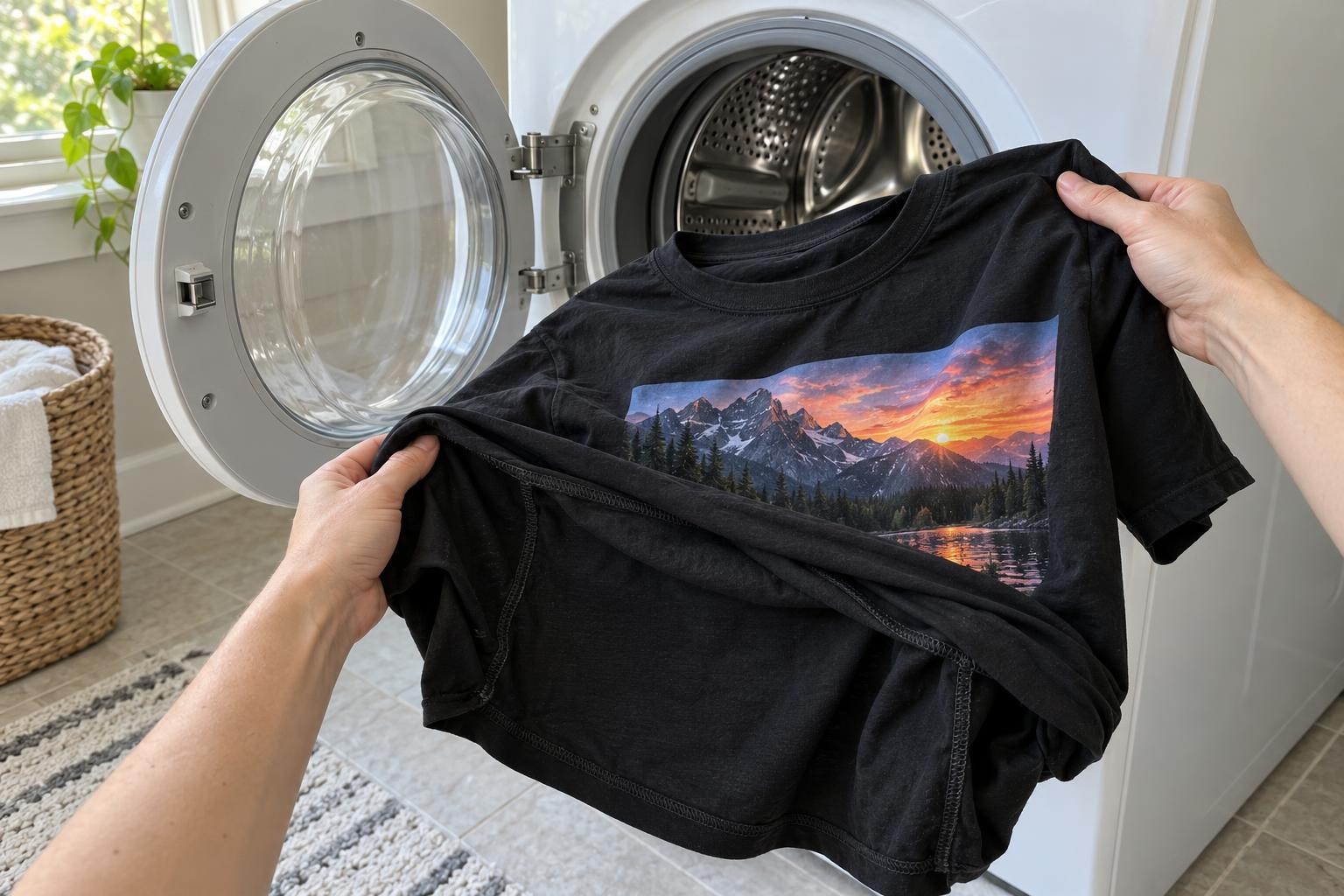
Turn the garment inside out before washing so the print rubs less against the drum.
Why the rules differ: where the dye sits
Sublimation
polyester fibres dyed from within
Harmful: bleach, harsh cleaning agents and excessive heat during care.
DTF print
colour ink
white underlay
adhesive
fabric fibres
Harmful: washing before the adhesive has set; hot water and strong dryer heat; bleach and fabric softener; dry-cleaning solvents; an iron on the face.
Heat-transfer film
film: polyurethane, PVC or flock
adhesive that melts under the press
fabric fibres
Harmful: washing within the first day; bleach and aggressive agents; an iron on the face. Hot water and a dryer shrink the cotton under the film, and the film wrinkles.
Layers on the fabric after pressing: sublimation dye enters the fibre, while DTF and film lie on it as a layer on adhesive.
Sublimation on polyester
Sublimation is printed on polyester, including T-shirts for sublimation and heat transfer. The dye enters the fibre, but care must protect both the fabric and the print: follow the stricter rule on the label or care card.
| Rule | What sublimation suppliers advise |
|---|---|
| First wash | after 24 hours |
| Inside out | yes: less friction on the face of the print |
| Water | Up to 30 °C. |
| Detergents | Mild, pH-neutral liquid detergent without bleach. |
| Fabric softener | better without it: one supplier advises doing without softener or using very little, another says not to use it at all |
| Spin and drying | Low spin speed; air-dry in the shade. |
| Dry cleaning | The shared care card says no dry cleaning. |
| Ironing | Low heat; iron from the reverse side through a thin cloth, without steam. |
Has the print faded after a few washes? Check the composition on the label: cotton does not hold sublimation dye, so on a cotton blend the print is paler from the start and fades faster. The reason is explained in the article on which fabrics suit sublimation.
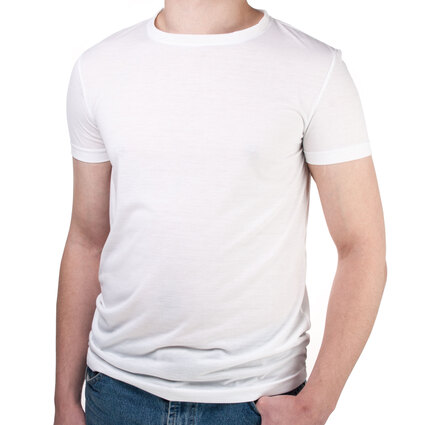
Men's sublimation T-shirt, polyester, white
Polyester, 170 g/m² · white · sizes XS to XXXL
DTF print
DTF means printing on film and then transferring the print to fabric: colour ink with a white underlay and adhesive. At MyPrint you can order DTF printing on film: the transfer arrives with the adhesive powder already applied and cured, and you transfer it onto T-shirts, hoodies and sweatshirts for printing with a heat press.
| Rule | What DTF transfer suppliers advise |
|---|---|
| First wash | after 24 hours; one supplier advises 24–48 hours so that the adhesive fully sets |
| Inside out | yes: less friction on the print |
| Water | 30 to 60 °C: suppliers disagree. The strictest sets 30 °C: hot water weakens the ink and the adhesive |
| Detergents | no bleach |
| Fabric softener | without it: one supplier names softener directly among the causes of cracks and lifting edges |
| Programme and spin | delicate programme |
| Tumble dryer | low heat, and air drying is better: strong heat can crack the print |
| Ironing | Low or medium heat; iron from the reverse side or through a cloth, without steam. |
| Dry cleaning | no: dry-cleaning solvents are incompatible with DTF ink |
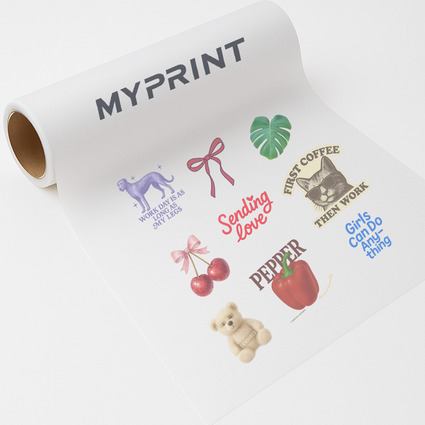
DTF printing on film, 1 linear m (1 × 0.6 m)
0.6 m wide, 1 linear metre · adhesive powder applied and cured
Heat-transfer film
A print made of heat-transfer film is a cut layer of polyurethane, PVC or flock with an adhesive that melts under the press. The safe temperature depends on the specific film: makers give limits from 40 to 80 °C.
| Rule | What heat-transfer film makers advise |
|---|---|
| First wash | after 24 hours: on this the makers agree |
| Inside out | yes, as for DTF |
| Water | 40 to 80 °C depending on the film and the maker. MyPrint's care memo says up to 40 °C: cotton shrinks in hot water but the film does not, and the print wrinkles |
| Detergents | no bleach or aggressive agents |
| Fabric softener | no liquid fabric softener, as in MyPrint's memo |
| Programme and spin | as on the garment label |
| Tumble dryer | most makers allow the normal setting; MyPrint's memo says low heat, because heat shrinks cotton |
| Ironing | Low heat; from the reverse side, without steam |
| Dry cleaning | most makers allow it, one forbids it. Without explicit permission from the maker of your film, keep “do not dry-clean” on the card |
Has the film already wrinkled after washing? What to do about it is in the article on wrinkled heat-transfer film.
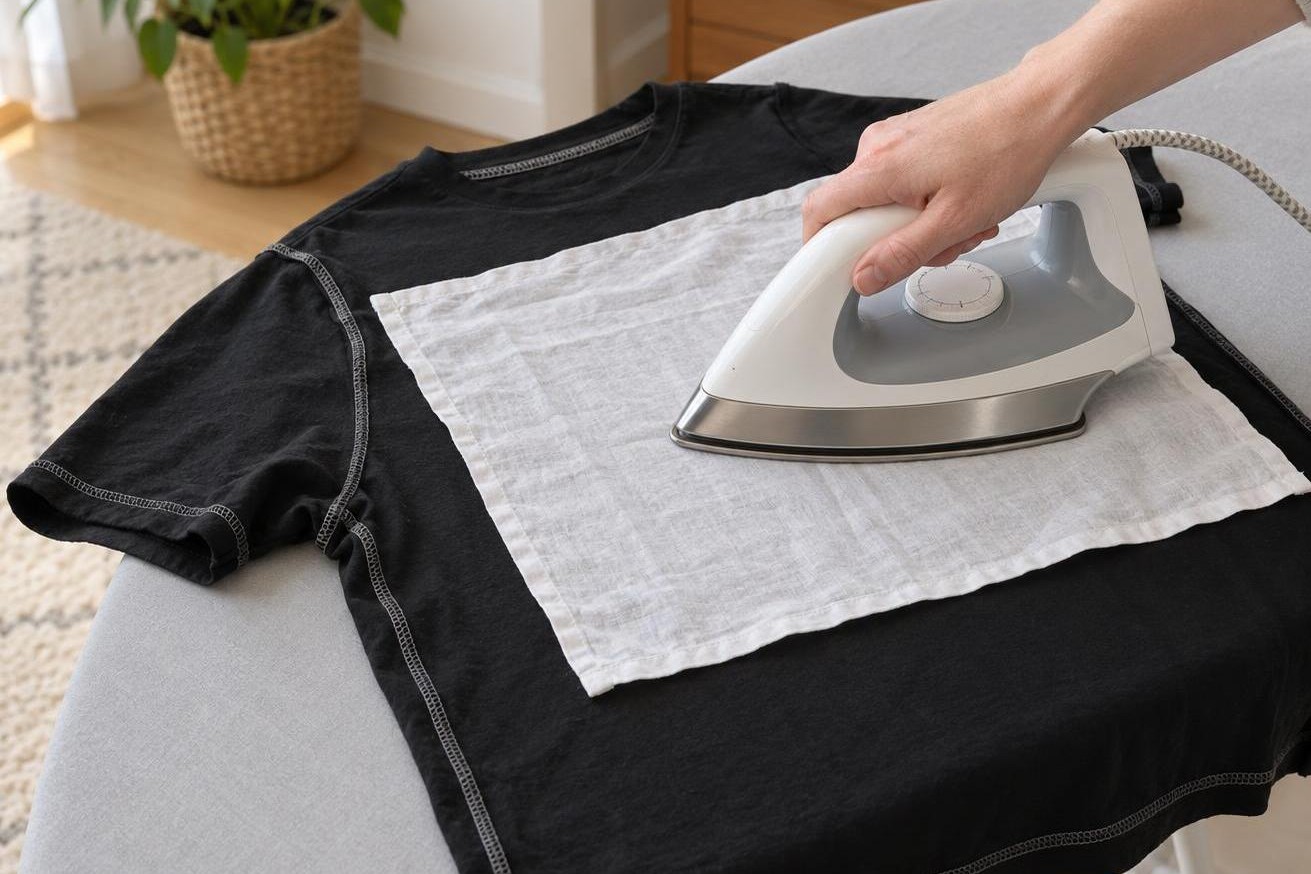
Iron the reverse side through a thin cloth and without steam: the soleplate never touches the print.
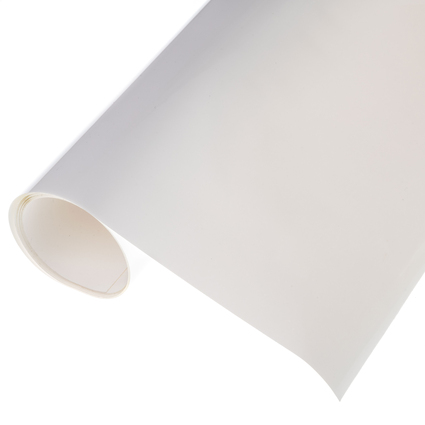
My Print High Flex PU heat-transfer film, white
Polyurethane 0.09 mm · press 150–160 °C, 10–15 s, medium pressure · peel the carrier after cooling
A customer complains about the print: what to ask
Before deciding whose mistake it is, ask for photos and find out how the garment was washed. The answers show what to check: care, pressing or the material.
| Ask | What the answer points to |
|---|---|
| Photos of the whole print, the defect close up and the garment label | Cracks in DTF: pressing, material, or heat in washing and drying. Lifted edges: the adhesive failed because the garment was washed too early, washed or dried too hot, or under-pressed. Faded colours: ask about detergent, temperature and drying. Sublimation already pale before washing: check the fabric composition and transfer settings; fading after washing: also check the care routine. Wrinkles in film: find out whether the garment itself shrank |
| When was it first washed? | Film washed before 24 hours, or DTF before the supplier's specified 24–48 hours: the adhesive bond may not have reached full strength |
| At what temperature and on which programme? Was it turned inside out? | A hot wash, a “cotton” programme, not turned inside out: the adhesive softens, the cotton shrinks, the face of the print wears off |
| Was bleach, stain remover or softener used? | Yes: colours fade, DTF and film edges lift |
| Was it tumble-dried, ironed over the print or dry-cleaned? | A hot dryer: cracks in DTF and wrinkles in film. An iron on the face damages the print. Dry-cleaning solvents are incompatible with DTF ink |
| After which wash did the defect appear? | After the very first wash done by the card: check the pressing and the material. Check the settings against the film's product card, and for DTF go through the five causes of cracks after washing |
| Your own check: are there complaints about other items from the same batch? | Several items: check the press settings and the material batch. One item: first find out how it was washed |
Keep one item from each run and wash it by the card yourself. If the test item held up and a customer complains, start the conversation with how they washed it. If the test item failed too, check the press and the material before printing the next batch.
Frequently asked questions
Can a printed T-shirt go in the washing machine?
Yes. Turn the garment inside out and choose a delicate programme at 30 °C.
How long after pressing can it be washed?
Film and sublimation after 24 hours, DTF after 24–48 hours depending on the supplier. The card says 48 hours so that it suits any print. This matters most when the customer collects the garment on the day it was pressed.
How do I iron a printed T-shirt?
Iron on low heat from the reverse side through a thin cloth, without steam. Do not touch the print with the soleplate.
Why did the print peel after the first wash when it was washed according to the label?
The label is sewn in by the garment maker and is about the fabric, not the print. The strictest DTF transfer supplier sets a limit of 30 °C, so 40 °C “as on the label” may already be too much for a DTF print. If it was washed by the card, look for the cause in pressing and the material.