

If one brochure panel folds inside, it needs room between the other two. That is why the nested flap is made slightly narrower. Three equal columns in a file do not necessarily make a sheet that folds neatly.
Choose the opening style and panel widths first, fold a paper dummy, then place the text. A brochure with a nested flap and an accordion brochure need different layouts.
Nested flap or accordion fold
A panel is the part of a sheet between an edge and a fold, or between two folds. Our brochure has three panels, two folds and six pages: each panel has two faces. A single panel can contain several text columns.
View of the top edge of each folded brochure. Layer spacing and fold curves are enlarged for clarity. Colours and letters identify panels; each diagram has only two folds.
Nested flap
C · A · B
Layers, top to bottom
1 · A → over B
2 · C ← over A
A sits between B and C. Both outer panels fold towards the inside face.
Accordion fold
A · B · C
Layers, top to bottom
1 · A → over B
2 · C ← under B
The outer panels sit on opposite sides of B. The two folds go in opposite directions.
In an accordion fold, the outer panels sit on opposite sides of the centre panel, so neither has to fit between the other two. An ordinary accordion on a 297 mm flat sheet can use 99 + 99 + 99 mm, with folds at 99 and 198 mm from the left edge. The two folds go in opposite directions.
If the customer wants a different opening style, the reading sequence changes too. Revise the fold construction, panel widths and content placement on both faces. Moving text within the old columns is not enough.
Marking both faces of one sheet
A hypothetical teaching example. Start with a trimmed sheet measuring 297 × 210 mm. Its inside panels have already been set at 97 + 100 + 100 mm, left to right. Look at the inside face with the top of the sheet at the top. The left flap, A, is 97 mm wide and folds right first; panel C closes over it with a second movement to the left.
The 3 mm difference is a condition of this example, not a universal folding allowance. For a real job, the reduction depends on the paper, fold construction, production template and folded sample. Do not automatically carry the same 3 mm over to heavier stock.
Turn the sheet left to right, keeping the top at the top
Turn it about a vertical axis, like a page in a book. These are two faces of one sheet: the panels appear in reverse order, but A remains the 97 mm flap. Dashed lines mark the same two folds.
Trimmed size: 297 × 210 mm
Inside face · A / B / C
↑ Top
97 + 100 + 100 = 297 mm
From the left edge: fold 1 at 97 mm; fold 2 at 197 mm.
A is the flap. B is the centre panel. C is the panel that closes the brochure.
Outside face · C / B / A
↑ Top
100 + 100 + 97 = 297 mm
From the left edge: fold 2 at 100 mm; fold 1 at 200 mm.
C is the front cover. B is the back. A is the reverse of the same flap.
Coordinates on the reverse: 297 − 197 = 100 mm; 297 − 97 = 200 mm.
The coloured areas show three panels in proportion to their widths, not separate sheets. The solid outline is the trimmed edge; bleed is not shown.
297 mm is the width after trimming. Bleed extends the print beyond the outer trim line. It is outside this 297 mm width: it neither reduces the panels nor creates an extra strip between them.
Two movements reveal the cover position
1. A right, over B
Fold on the 97 mm line. In the flat geometric model, flap A covers B from 97 to 194 mm. This leaves 197 − 194 = 3 mm before the next fold at 197 mm.
That is a difference between coordinates in the diagram, not a measured gap in a finished brochure: real paper has thickness and a fold has a curved profile.
2. C left, over A
Close panel C along the 197 mm line. Flap A sits between C and B. The outside of C becomes the front cover, and the outside of B becomes the back of the brochure.
When the reader opens C to the right, the reverse of flap A appears. A then unfolds to the left, revealing the entire inside face.
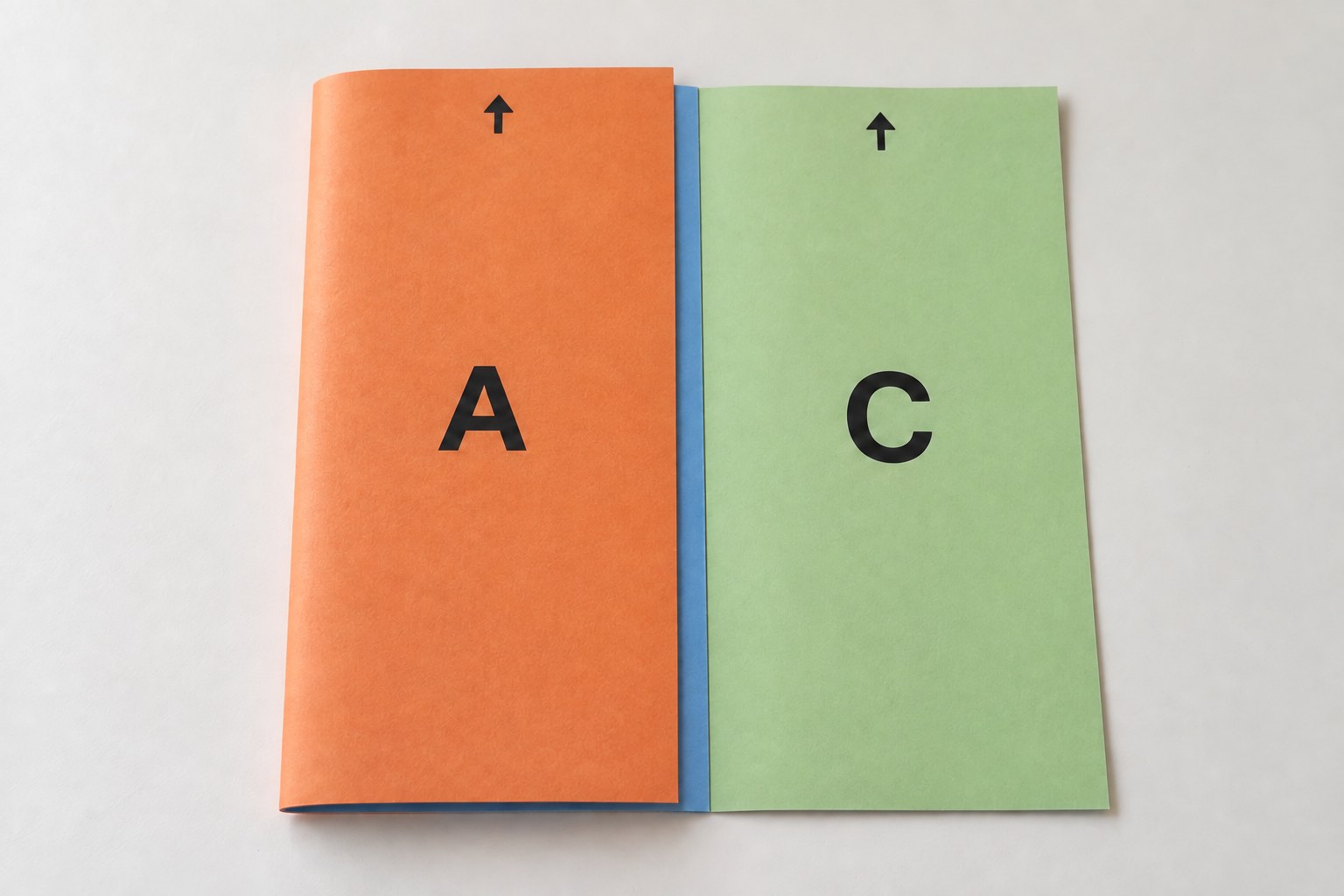
After the first fold, flap A lies on B. Its free edge must fit before the B/C fold; C then closes over the flap.
A paper dummy that answers layout questions
Use the stock intended for the job to make one labelled paper dummy. For this example, trim it to 297 × 210 mm. If the production template specifies different panel widths, check those instead.
- Mark the orientation and panels. Draw a “top” arrow on both faces. On the inside, label A, B and C and mark the 97/197 mm lines. Turn the sheet left to right, keeping the top at the top: the reverse reads C, B, A, with lines at 100/200 mm.
- Fold in the intended order. Return to the inside face: first A right onto B, then C left over A. On heavy stock, prepare the folds using the method intended for production. The flap should fit without hitting the opposite fold or bowing because it catches there.
- Mark content with the brochure closed and open. Write “front cover” on the outside of C and “back” on the outside of B. Add the names of the planned content blocks to the flap and inside panels. Open the brochure as a reader would and check when each block appears.
- Transfer the result to the file. Unfold the dummy and compare both faces with the guides and text. If the flap catches or the cover is in the wrong place, correct the geometry or content layout as appropriate, then fold a new sample before printing the run.
Once the fold positions are confirmed, browse the MyPrint category for creasing machines for preparing fold lines. Match the working format and supported stock of the particular model to your job on heavy stock. Creasing prepares a fold line. Panel widths belong in the layout; automatic folding is a separate function to check in the machine's specifications.
Keep the labelled dummy with the file. It shows more than two fold positions: it records how one double-sided sheet becomes a brochure and the order in which its content is read.