
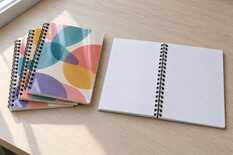
A batch of 20 A5 notebooks with 50 sheets each takes 8 guillotine cuts, 86–88 punches and 20 closings: in the example below that is 80–155 minutes of hands-on work, printing not included. Take 3:1 wire, 9.5 mm in diameter, and shorten it to 24 loops. Before the batch, punch one sheet and assemble one notebook, so that a half hole at the edge or the wrong diameter does not spoil all twenty.
3:1 wire
9.5 mm
50 sheets plus covers
Loops on the 210 mm side
24
on the 148 mm side: 17
Punch at a time
up to 20
sheets of 80 g/m²
Free strip at the wire
10–15 mm
no lines or text
A block of 50 sheets of 80 g/m², a 300 g/m² cover under a 200 µm clear cover, a 230 g/m² back cover, a binder with 3:1 pitch (8.47 mm).
3:1 metal wire is the usual choice for a notebook: it opens 360° and lies flat. How it differs from comb and glue binding is covered in the article on choosing a binding for a report, menu and catalogue.
What to prepare for 20 notebooks
Materials and tools
The binder needs 3:1 pitch (8.47 mm) and disengageable pins: on A5, 24 of the 34 pins do the work, and the one that cuts into the edge is switched off. The basic one at MyPrint is the WB Base 619: it punches up to 20 sheets at a time, the hole margin adjusts within 2.5–6.5 mm, and it closes wire up to 14.3 mm; UAH 6,825 as of October 2026. The WB Pro 970 does the same and also takes 2:1 wire for thick blocks and the A3 format.
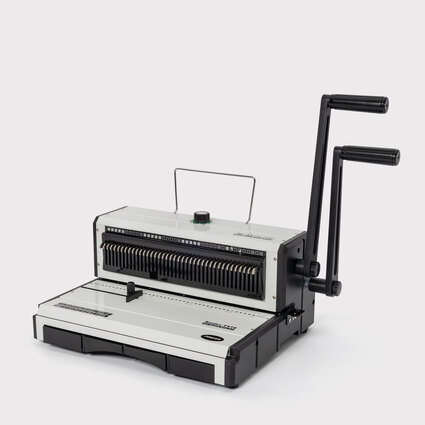
Manual metal wire binder My Print WB Pro 970
3:1 and 2:1 wire · A5 with the extension guide · up to 20 sheets at a time · disengageable pins · UAH 13,950 as of October 2026
File and printing
Lay out the file for the wire
The page is A5, 148 × 210 mm. Place lines and text 10–15 mm from the wire edge: the far side of the 4 × 4 mm hole will be 6.5–10.5 mm from the edge of the sheet. Keep lines at least 5 mm from the other three edges, and no bleed is needed. For double-sided printing, make the left and right margins equal, so you do not have to swap them on the back. Give the cover a 3 mm bleed, i.e. 154 × 216 mm, and keep the logo 10–15 mm from the wire as well.
Block pages
Two A5 per A4 sheet
No bleed, one cut down the middle. 500 sheets for the batch.
Cover with bleed
One per A4 sheet
Two do not fit: 2 × 154 = 308 mm, while A4 is only 297. Four cuts for the whole stack.
If you print on SRA3
Four covers per sheet
320 × 450 mm holds 2 × 154 and 2 × 216 mm. Cut such a sheet on an A3 guillotine.
Print at 100 % scale
In the print dialog choose “Actual size”, not “Fit to page”. Check the first sheet with a ruler: the free strip and margins match the layout, and the crop marks on the cover give 148 × 210 mm. Let laser sheets cool and lie flat. Do not stack inkjet prints right away: a photo paper maker advises letting each sheet lie on its own for at least 15 minutes.
Cutting and choosing the wire
Cut everything to A5
A ream of 500 A4 sheets of 80 g/m² is 52–55 mm thick, while MyPrint's manual A4 guillotines take a stack of up to 40 mm, about 400 sheets. Before each cut, align the stack against the backstop and clamp it with the screw clamp. Cut the ream in two stacks of 250: back gauge at 148.5 mm, and check the first cut with a ruler. Cut the covers (22 sheets, about 6 mm) in one stack with four cuts; put a sheet of card on top so the clamp leaves no marks on the print. Cut the clear and the card back covers in half, one cut each. That is 8 cuts in total.
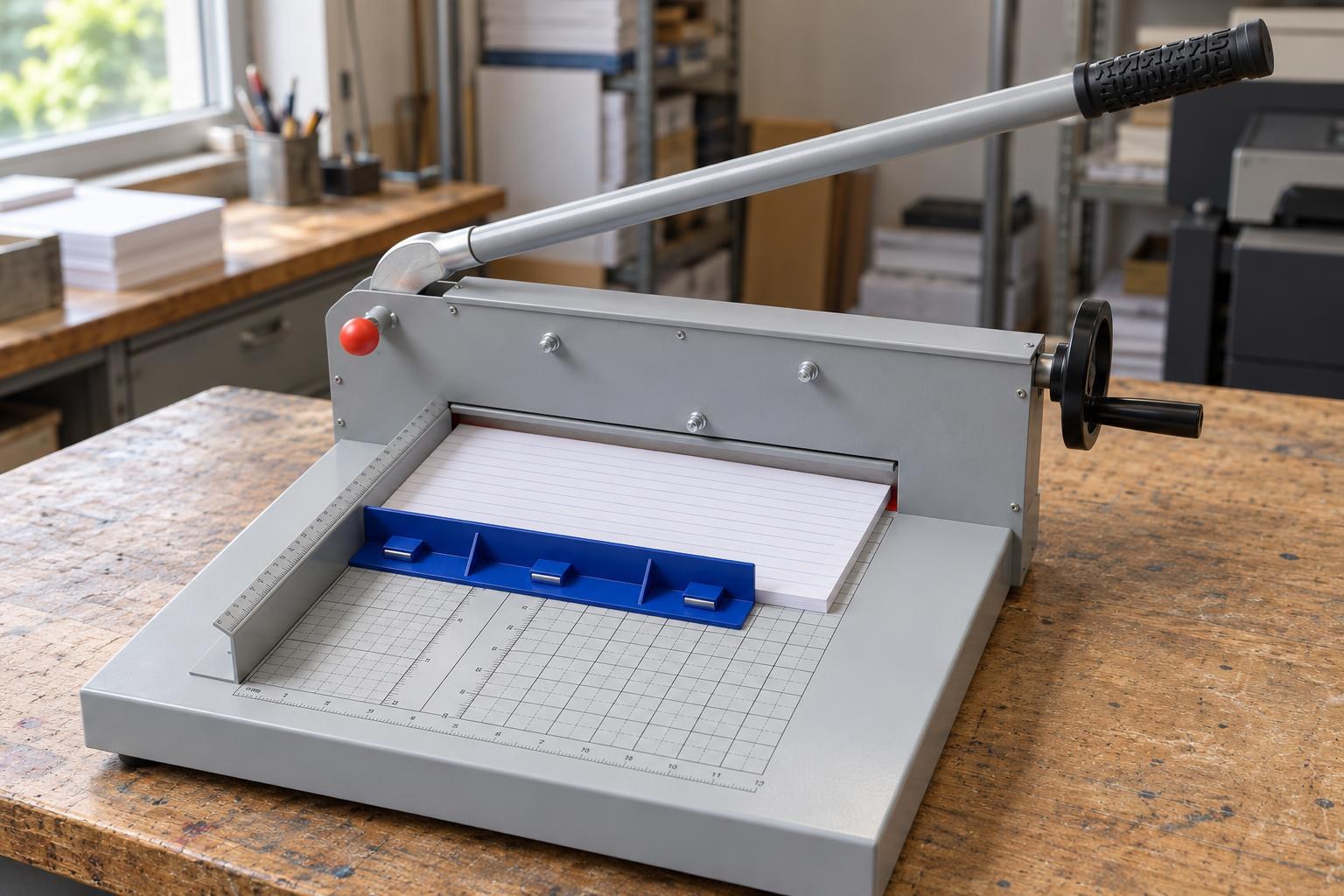
A4 sheets are cut in half in two stacks: gauge at 148.5 mm, stack no higher than 40 mm.
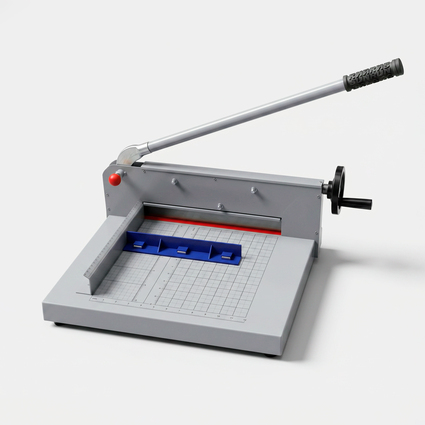
Manual guillotine paper cutter My Print GC Base 198 A4
Stack up to 40 mm, about 400 sheets of 80 g/m² · 300 mm cutting width · magnetic stop · UAH 6,550 as of October 2026
Measure the block and choose the wire
Count 50 sheets, put the clear cover and the printed cover on top and the back cover underneath, and measure the thickness without pressing: about 5.7–6.3 mm. The covers add roughly the thickness of seven more sheets. According to MyPrint's cards, 7.9 mm wire holds 30–50 sheets of 80 g/m² and 9.5 mm holds 50–75, so for 50 sheets plus covers take 9.5 mm. How to work out other blocks is in the article on wire pitch and notebook thickness.
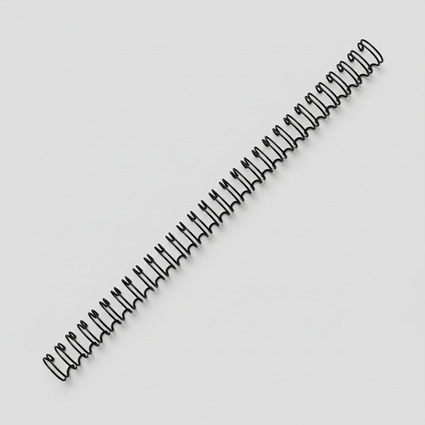
Metal wire A4, 3:1, 34 loops, 9.5 mm, black
50–75 sheets of 80 g/m² · 100 pcs per pack · UAH 342 as of October 2026
Punching
Punch one sheet and shorten the wire
Punch one A5 sheet along its long side. The 210 mm edge should get 24 whole holes, with the end holes at the same distance from the top and bottom edges. If an end hole runs into the edge, move the side guide; if that does not help, switch off the pin that cuts the edge (how to set up the punching). First set the hole margin from the edge to its middle value, 4.5 mm. Then cut 10 loops off the wire with side cutters, exactly between two loops so the end loops stay whole: the wire must have as many loops as the test sheet has holes.
Punch up to 20 sheets at a time
The binder punches up to 20 sheets of 80 g/m² at a time, so punch a 50-sheet block in three goes: 20 + 20 + 10. Each time, knock the sheets straight on the table and push them against the same side guide, or the holes will not line up. Count the 300 g/m² cover and the 230 g/m² back by thickness: each equals 2–3 sheets, so up to seven at a time, and fewer if the handle goes stiff. Punch the clear cover one at a time between two sheets of 80 g/m² paper, and the holes come out clean, without tears (how to punch a clear cover).
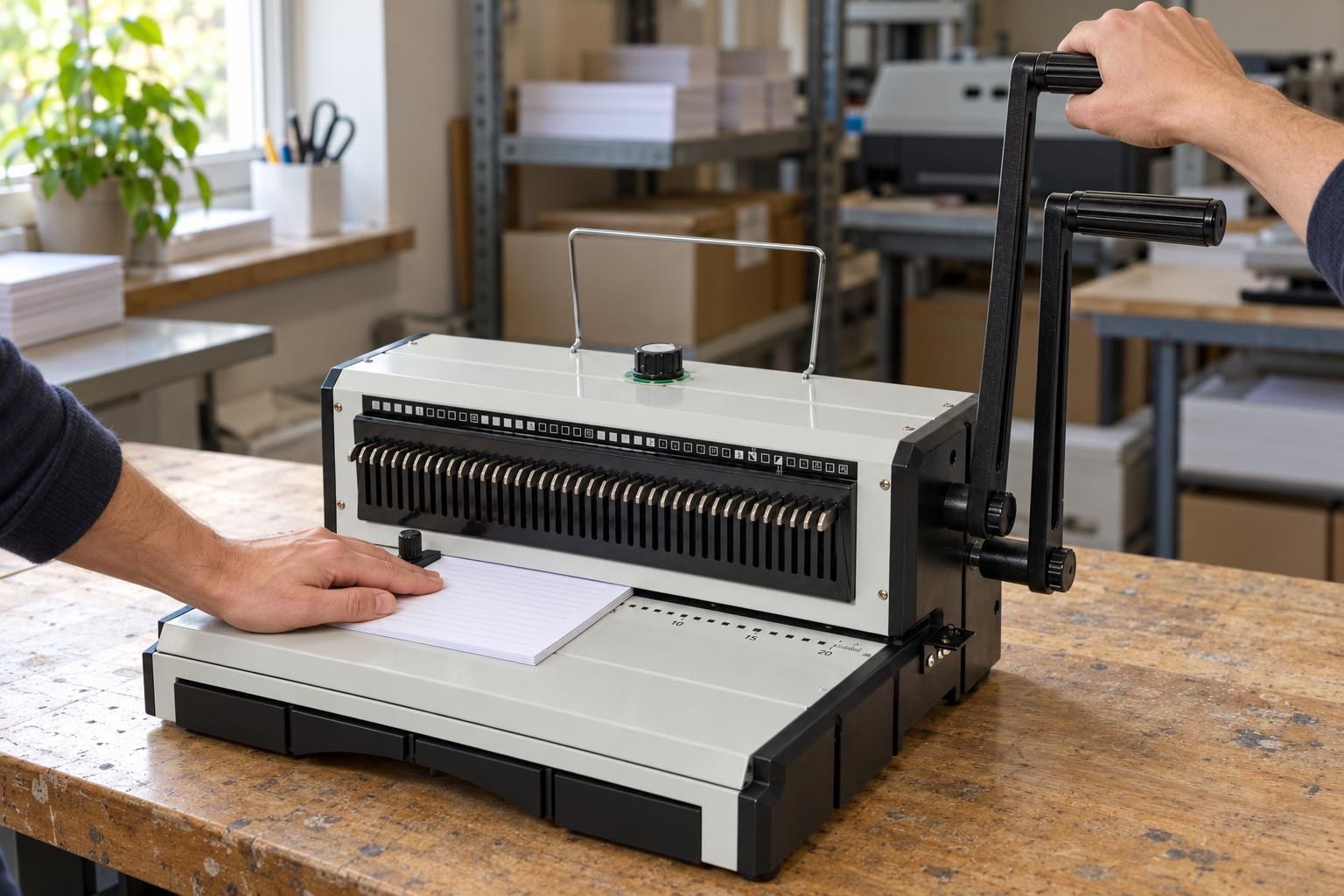
Twenty sheets in the slot: the edge is pushed against the side guide, as with the test sheet.
Assembly, checking, packing
Assemble, close and hide the seam
Place the back cover not under the block but on top of the clear cover, outer sides together, and put everything on the wire. Set the closer to 9.5 mm, close the first notebook and flip the back cover round: the seam of the wire hides behind it (more about the seam). Check the closure along the whole length: no sheet should slip through the gap, and the loops should not squash into ovals (what to do when sheets fall out). Only then assemble the other 19.
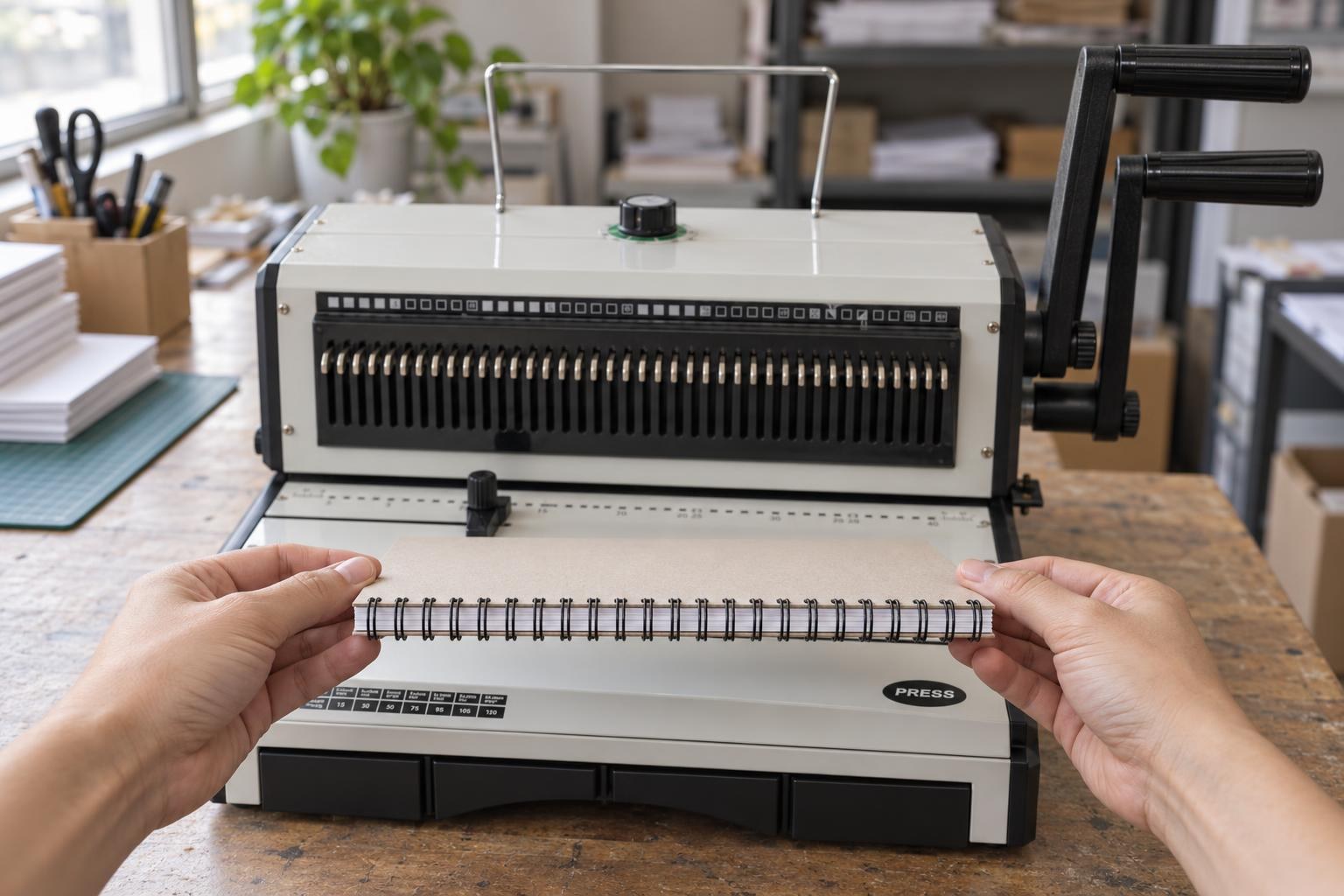
Closing: the loops meet into a ring, and the closure is even along the whole wire.
Check every notebook
Check each notebook against four points:
Before packing
Pack the batch
Stack the notebooks with the wire alternating sides: the wire edge is thicker, and without alternating the stack leans and the bottom loops get crushed. Wrap packs of 5 or 10 in film or put them in a box. Interleave fresh inkjet covers with a sheet of paper.
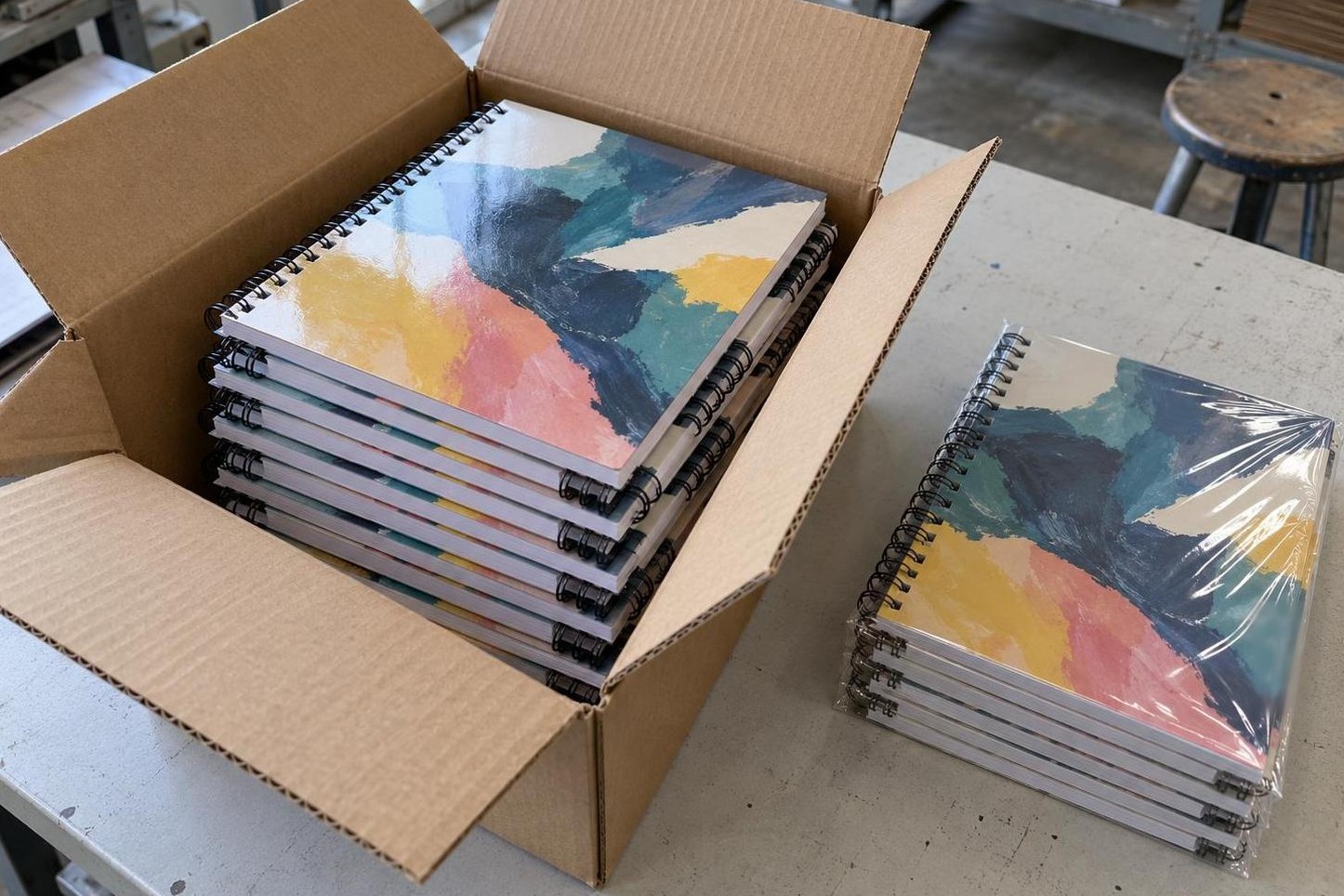
The finished batch: the wires alternate sides, so the stack lies flat.
How long a batch of 20 takes
The minutes per operation below are a guide for one person with a manual binder and a guillotine, printing not included. Time the operations on your first notebook and put in your own figures.
Example: 20 A5 notebooks of 50 sheets, 9.5 mm wire
That is 1 h 20 min to 2 h 35 min for one person. The cost of the MyPrint wire and covers:
Consumables per notebook, prices as of October 2026
For a batch of 20 that is UAH 135.20; add paper, cover card and printing at your own prices. The three packs together cost UAH 1,010, and their wires are enough for 100 notebooks.
What slows a batch down
- Blocks: up to 60 of the 155 minutes go on counting and jogging. Count out the sheets for the blocks while the printer runs the covers.
- Rework. A half hole at the edge means reprinting the blocks; the wrong diameter of 3:1 wire means replacing the wire. The test sheet and the test notebook take 5–10 minutes.
- Clear covers: 20 punches one at a time, almost a quarter of all punches. Price them in separately.
- Manual punching. For regular batches there is the electric WB Auto 8707 with a foot pedal: up to 30 sheets of 70 g/m² at a time, which by thickness is about 26 sheets of 80 g/m². A block takes two punches instead of three, and your hands stay free for jogging. For 20 notebooks a manual binder is enough.
- A tear-off line on every sheet is a separate job: on a manual creaser with perforation the sheets go through one at a time, which means another 1000 passes per batch. Charge it as a separate service; the machines are in the Creasers and perforators section.
Frequently asked questions
Wire at the top instead of the side: what changes?
The wire goes on the short side, 148 mm. That side takes 17 holes, so one A4 wire with 34 loops splits in half for two notebooks. Keep the 10–15 mm free strip at the top edge then, and punch the test sheet along the short side.
What if the notebook has 100 sheets?
Work it out the same way: the covers add the thickness of about seven more sheets, about 107 in total. That calls for 14.3 mm wire (105–120 sheets on the card), the largest 3:1 wire in MyPrint's range and the limit of the WB Base 619. A block takes five punches, and the free strip at the wire should be at least 12 mm.
Can you make a wire-bound notebook without a binder?
Not for a batch. 3:1 wire fits only holes at 8.47 mm pitch punched evenly along the whole edge, and only a closer gives an even closure. A manual binder with this pitch does both.
Can the same batch be done on plastic coil?
Yes, but on a coil binder with a different hole pitch: coil is not closed but spun in. Bend the ends on both sides, or it works its way out of the notebook (why bend both ends).