
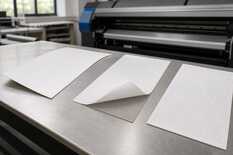
Choose paper, self-adhesive film or banner first by how the carrier will be held after printing: paper needs support or protection, film works through contact with a compatible surface, and banner carries the image in its own fabric between attachment points. Only then match the exact material to the printing system, finishing and installation conditions.
Ask one question: what physically holds the graphic
Do not begin with material names in a catalogue. Draw a cross-section of the assembly: substrate, printed carrier, adhesive or mechanical attachment, and protective layer. This sketch quickly eliminates two of the three classes.
Paper is a candidate when the print sits in a frame, poster holder, display or another protected structure.
Self-adhesive film is a candidate when the graphic must adhere to a prepared substrate and follow its plane.
Banner is a candidate when the image hangs or is tensioned between eyelets, a frame or other attachment points.
If the image is printed directly on a rigid sheet, fabric or another surface and uses none of these three carriers, this comparison does not apply. Define the material, application technology and construction separately for that product.
Choose paper for a controlled environment and support
Paper is appropriate when the construction does not require the print itself to carry tension, withstand bending or adhere to a substrate. Before ordering, determine whether there will be a frame, protective plastic, backing, illumination, moisture exposure, and the viewing distance for the artwork.
Decision: if unsupported paper is expected to act as a self-supporting outdoor sheet, the brief is contradictory. Return to banner or design a rigid substrate and protection.
For film, the surface matters more than the word “self-adhesive”
Record the substrate material and condition: smooth or textured, painted or untreated, flat or curved, clean and dry or not. Then determine whether future removal without an unwanted trace is required. Face-film properties, adhesive, substrate and environmental exposure work together, as the Avery Dennison technical bulletin on removing self-adhesive films stresses.
- “Easy to remove” is not a property of every film; it must be confirmed for the exact combination of film, adhesive, substrate and service period.
- Texture, a weak coating or contamination can make even a film that fits the print format fail.
- On a critical or unknown surface, run the test specified by the material manufacturer instead of relying on a category-name promise.
A banner starts with the structure, not the print mode
For freely hung or tensioned fabric, record the real size, installation location and viewing direction, tensioning method, edges and attachment points. This article does not calculate an edge, fastening or load; determine those separately for the actual structure and installation site. Choosing printable fabric does not replace that stage.
Take the required weight, base construction, ink compatibility, edge-finishing method and permitted conditions from the documentation for the exact material and system. The word “banner” alone does not provide a universal service life.
Reduce the choice to the installation scenario
Do not order material until the substrate or attachment method, printing system, required finish and manufacturer’s rules are known. For film, add a test on the real surface; for a hanging structure, add a separate fastening-safety check.
If film wins, move to the exact type
The MyPrint section lets you compare films for inkjet printing once the installation scenario already points to a self-adhesive carrier. Before choosing, match the product page and technical description of the exact film to your ink, surface, finish and removal method.
View films for inkjet printing at MyPrintIf the assembly points to paper or banner, do not force the job into this catalogue: record the appropriate carrier class and find the material through its documentation.