
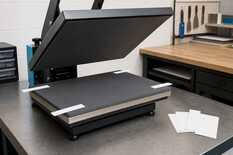
Check heat-press non-uniformity without disassembly by making two separate maps: a cold contact test shows whether the platens close evenly, while a manufacturer-approved temperature test shows whether their zones heat evenly. If the defect repeats in the same platen location, stop the run and send the map to service instead of compensating with time or temperature.
First prove that the defect is tied to the platen
Mark the top, bottom, left and right edges of the working area. On small identical blanks, run a control with the current material recipe that has already produced a good result. Without changing the file, rotate or move the layout so that the same element reaches another zone.
Prepare the press without a hidden change in conditions
- Record the model, serial number, material, current transfer conditions and defect location on the platen.
- Inspect the working surfaces and pad without disassembly for residue, folds, skew, damage or an object creating local height.
- Shut down, cool, clean and access the platens only as the instructions for your exact model require.
- Do not adjust assemblies between tests. Otherwise the map will no longer describe one press state.
Do not touch a hot platen, bypass guards or work with your hands inside the press. If the manual prohibits the test described or does not explain safe access, stop and hand the diagnosis to authorised service.
Make a relative contact map on a cold press
If the model instructions allow a cold clamping test, place four identical strips of plain paper near the corners of the working area, leaving their ends outside. Close the press normally without heat, then compare pull resistance one strip at a time. Use identical strips and do not try to turn a hand sensation into a number.
Whether all four strips are held alike and whether the weak zone repeats in another test.
Pressure force in units, recipe suitability or heater condition—the paper map measures none of these.
This comparison of corner strips is included in the official STAHLS heat-press test kit. It is a useful relative-mapping principle, not a universal pressure standard for every model.
Map temperature separately with a method approved for the model
Use temperature strips, a contact probe or another method explicitly approved by the manufacturer of your press. After the same warm-up, measure all four corners and the centre, and record the actual values with the stabilisation time. Do not combine results from different instruments into one map.
Compare the map with the model’s service documentation and your transfer-system requirements, not with a random online tolerance. An infrared instrument may depend on the surface and measurement method; without a validated procedure, its reading is not an automatic verdict on the platen.
Compare the two maps and choose the next action
Weak contact, even temperature. Do not compensate with heat. Give service the contact map, photos of the working surfaces and model details so they can check geometry, the pad and the closing mechanism.
Even contact, colder zone. Do not raise the overall temperature for the entire run. Record the map and contact service about the heater, sensor or controller.
Both maps are even. Return to the blank, print, moisture, fixation and transfer recipe. The local platen-fault hypothesis is not confirmed.
The result does not repeat. Do not repair from one print. Repeat the control with the same method or give the measurements to a specialist.
Compare equipment only after a service conclusion
If service confirms that repair is impractical, or your work needs a different press format or construction, you can compare heat presses in the MyPrint section. Choose a model by the real blank size, service support, available documentation and testing of your process.
View heat presses at MyPrintIf the maps are normal, new equipment is not the conclusion of this check: first find the variable in the material or process.